Vitamin B12 is an essential nutrient. In plain English, that means we need to get it from an outside source. It matters for red blood cell production, brain function, and normal cardiovascular metabolism, so this is not a nutrient we want to leave to chance.
There are three reliable ways to get it: animal products, fortified foods, and supplements. All three can work. The trick is knowing what each provides, what your body can absorb, and which approach you can actually stick with.
And no, eating some animal products does not automatically mean your B12 needs are covered. There are a few details worth getting right.
Key Takeaways
- Animal products, fortified foods, and supplements are the three established sources of vitamin B12.
- Absorption limits mean B12 dose size and frequency both matter.
- B12 deficiency can affect people who eat animal products as well as vegetarians and vegans.
- A normal blood B12 result does not always rule out functional deficiency.
Table of Contents
- Why the B12 in Your Gut Does Not Cover Your Needs
- Animal Foods: Some B12 Sources Are Better Than Others
- Fortified Foods: A Reliable Plant-Based Option
- B12 Deficiency Is Not Just a Vegan Issue
- Vitamin B12 Supplements: Which Type Makes Sense?
- How Much Vitamin B12 Do You Need?
- Are B12 Supplements “Unnatural”?
- Can You Rely on Mushrooms, Algae, Tempeh, or Duckweed?
- Choose a B12 Plan You Can Maintain
Why the B12 in Your Gut Does Not Cover Your Needs
Some bacteria make vitamin B12, including bacteria living in our colon. Convenient, right?
Not quite. They produce it downstream from the part of the intestine where B12 is normally absorbed. Too little help, too late in the plumbing. That is why we still need a reliable external source.

Animal Foods: Some B12 Sources Are Better Than Others
Animal foods vary enormously in their B12 content. Treating them as interchangeable can make dietary planning a little misleading.
- Liver: A very concentrated source because this is where B12 is stored. A slice can contain several times the daily requirement.
- Fish and seafood: Often rich sources. A salmon fillet can exceed the adult daily requirement.
- Chicken: Contains considerably less B12 than liver or many fish.
- Cow’s milk: Contributes B12, but it takes a substantial amount to cover requirements on its own.
- Eggs: Contain B12, but the fraction absorbed is relatively low.
To put the last two into perspective, estimates that account for absorption suggest roughly four cups of regular cow’s milk would be needed to cover daily B12 requirements. For eggs, low bioavailability can push estimates into the dozens. These are illustrations of why relying on either food alone is inefficient, not suggested serving sizes.
With a variety of animal foods, the contributions add up. But the whole food still matters. Getting enough B12 by eating large quantities of a less effective source may also mean taking in substantial saturated fat or cholesterol. Eggs and liver, for example, are concentrated sources of dietary cholesterol. Fish can be a more practical overall option.
The important point is not that everybody needs to eat fish or liver. It is that “I eat animal products” is not a complete B12 plan. Which foods, how much, and how often all matter. Vegetarians relying mainly on milk and eggs should pay particular attention.
Age and stomach acid can change the equation
In animal foods, B12 is bound to protein. The acidic environment in the stomach helps release it so it can be absorbed.
In fortified foods and supplements, B12 is already in a free form. It does not need that same protein-release step. This gives those sources an advantage when stomach acid is low, although it does not eliminate every possible absorption problem.
Reduced stomach acidity becomes more common with age. Some people over 50 or 60 therefore have trouble getting enough B12 from animal foods, even if their intake looks reasonable on paper.
Acid-reducing medications, including proton pump inhibitors, and certain medical conditions can create a similar issue. If animal foods are your main source, these are factors to discuss with your clinician.
Fortified Foods: A Reliable Plant-Based Option
Fortification simply means B12 has been added to a food. Common examples include:
- Breakfast cereals
- Plant milks
- Nutritional yeast
- Some juices
- Some plant-based meat alternatives
Depending on the product, a serving of cereal or a cup of fortified plant milk can supply the adult daily requirement. Check the label rather than assuming the whole category is fortified. The useful information is the B12 amount in the portion you actually consume.
Here is a result that surprised me: in the US dietary data cited for this discussion, breakfast cereals contributed more B12 than any other individual food source. Not liver. Not salmon. Breakfast cereal. Live and learn.
Why spreading B12 foods across meals helps
There is a catch with both animal foods and fortified foods: we do not absorb all the B12 we consume. The main absorption system has limited capacity and becomes saturated fairly quickly.
So a food containing a full day’s requirement does not mean every microgram will make it into your body. A prudent food-based approach is to include a B12 source two or three times a day, spaced across meals.
For fortified foods, that might mean fortified cereal at breakfast and a cup of fortified plant milk later. The principle is repeated opportunities for absorption, rather than putting the entire day’s B12 into one sitting.
B12 Deficiency Is Not Just a Vegan Issue
It is tempting to assume everybody already knows to secure another B12 source when cutting back on animal products. Then you look at the deficiency research, and your chin meets the floor.
A review of B12 deficiency among vegetarians includes individual studies reporting deficiency in more than 60% of some vegetarian groups, and around 55% in some groups of children. Those figures describe particular populations, not every vegetarian population. Still, they are a strong reminder that this nutrient needs deliberate attention.
People who eat meat can be deficient too. Food choices are only part of the picture; absorption matters as well.
Our B12 stores can last for a couple of years, which means an inadequate intake may not cause obvious problems immediately. Feeling fine for a while is not proof that your long-term supply is adequate.
Symptoms worth taking seriously
Common symptoms of vitamin B12 deficiency include:
- Fatigue and weakness
- Numbness
- Pale skin
- Memory problems
- A swollen tongue
These symptoms do not diagnose B12 deficiency by themselves. They are a reason to seek medical assessment, not a reason to guess at a diagnosis.
A normal blood B12 result may not tell the whole story
Blood testing can help assess B12 status, and home test kits are available. But interpreting a result is not always as simple as checking whether it falls inside the laboratory’s reference range.
It is possible to have a normal blood B12 concentration while B12 availability within tissues is already inadequate. In other words, the circulating number does not always capture what is happening where the vitamin needs to work.
Methylmalonic acid, or MMA, can be a more sensitive marker of functional B12 status. If deficiency is suspected, ask your doctor whether MMA testing would help clarify the picture.
Vitamin B12 Supplements: Which Type Makes Sense?
If you would rather not organize multiple meals around B12, a supplement can be the simple option. I am very sympathetic to simple.
Swallowed tablets versus dissolving tablets
You can swallow a B12 pill or use a tablet that dissolves in your mouth, often sold as sublingual B12. A head-to-head comparison of oral and sublingual B12 found both approaches worked. The dissolving version does not automatically get a gold medal.
Choose the format you prefer and will use consistently. Liquid preparations and sprays are also available, although shelf life can be shorter.
B12 injections have a role in medical care. People with conditions such as pernicious anemia may need them, depending on their circumstances and treatment plan. For most people, however, an oral supplement is a workable route.
Cyanocobalamin versus methylcobalamin
Many supplements contain cyanocobalamin, an effective form of B12. Another common form is methylcobalamin. The ingredient list tells you which one a product contains.
Kidney disease is a reason to discuss the formulation with your clinician rather than choosing solely on price or marketing. Methylcobalamin may be considered in that setting. That is a specific medical consideration, not a reason for everyone to avoid cyanocobalamin.
How Much Vitamin B12 Do You Need?
The recommended dietary allowance, or RDA, for most adults is 2.4 micrograms per day. We are talking about tiny quantities:
- One milligram is one-thousandth of a gram.
- One microgram is one-thousandth of a milligram.
- That makes one microgram one-millionth of a gram.
Some researchers have proposed somewhat higher adult intakes, around 4 to 7 micrograms daily. That is separate from the established RDA. Children generally need less, depending on age, and pregnancy and breastfeeding have different requirements.
The NIH vitamin B12 fact sheet provides reference information on requirements and absorption for different life stages.
Daily and weekly supplement schedules
Supplement doses look much larger than the RDA because the amount swallowed is not the amount absorbed.
A randomized trial in vegans and vegetarians with marginal B12 deficiency tested two schedules that improved B12 status:
- 50 micrograms daily
- 2,000 micrograms once weekly
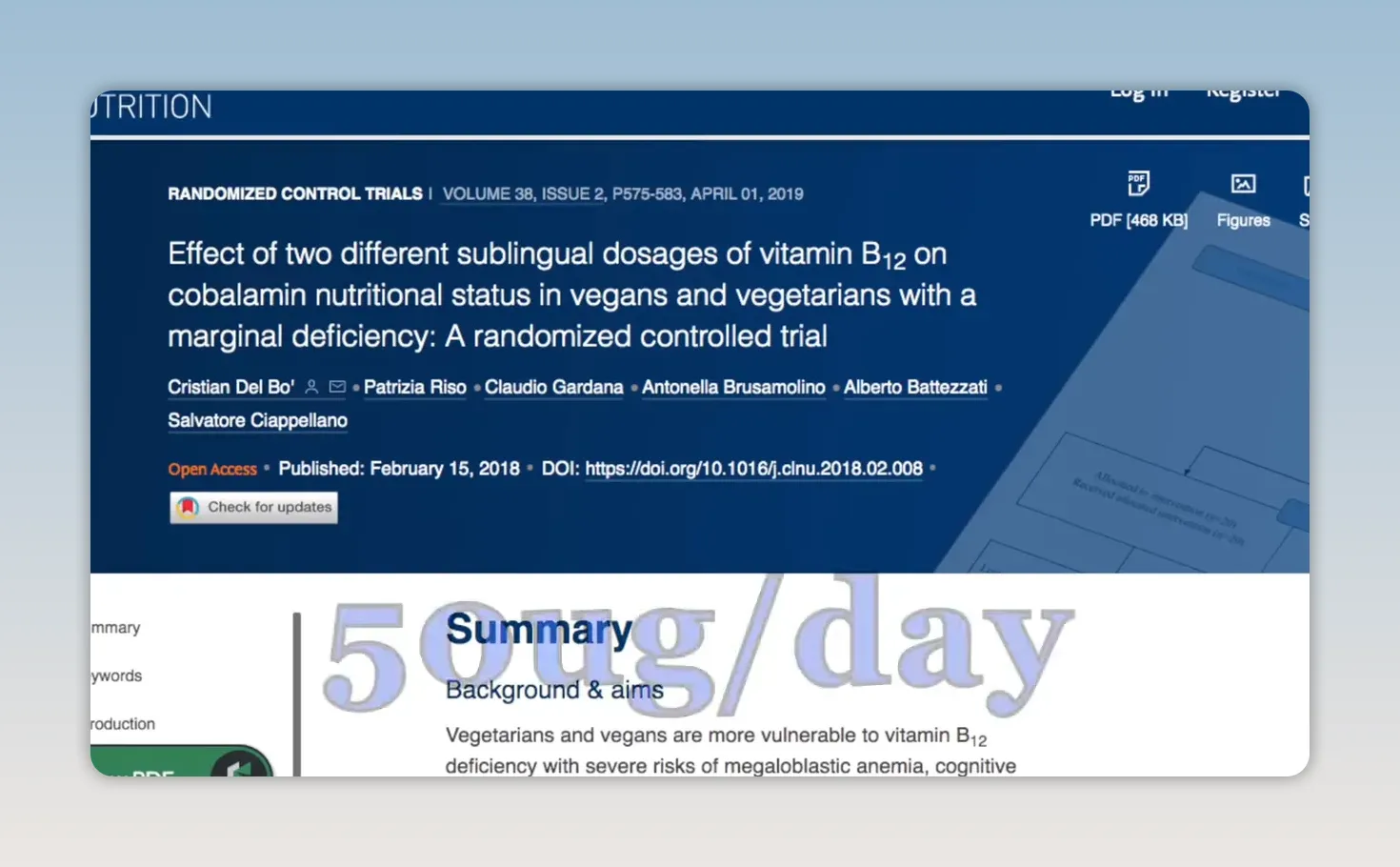
These are useful evidence-based examples, not a personalized prescription for every age, medical condition, or degree of deficiency. If your B12 is already extremely low, you may need a different treatment dose and medical follow-up.
Why 50 daily does not become 350 weekly
At this point, the arithmetic department may have an objection. Fifty times seven is 350, not 2,000. Correct. Full marks.
The missing piece is absorption. As a B12 dose increases, the percentage absorbed decreases. A large weekly dose therefore needs to be proportionally bigger than the sum of seven smaller daily doses.
You cannot simply multiply a daily schedule by seven and assume the result will work equally well once a week.
Cost can be modest, too. One example I checked worked out to about six cents per week. Prices vary, of course, but this does not necessarily require an expensive supplement routine.
Are B12 Supplements “Unnatural”?
That depends on what we mean by natural. If the definition is “something our distant ancestors did,” then supplements probably do not qualify. Neither do antibiotics, surgery, anesthetics, vaccines, or quite a few other things we are happy to use.
We generally make those decisions by weighing benefits and risks, not by asking whether a person living in a cave had access to them.
There is another wrinkle: farm animals may themselves receive B12 supplementation. In some cases, getting B12 through animal products means getting supplemented B12 indirectly.
None of this means everybody must take a pill. It means naturalness is not the most useful test of whether a B12 source is appropriate. Reliability, absorption, convenience, and the rest of your diet are better criteria.
Can You Rely on Mushrooms, Algae, Tempeh, or Duckweed?
B12 has been detected in tea leaves, tempeh, certain mushrooms, several types of algae, and some organically grown vegetables. Plants can sometimes take up B12 associated with manure. Duckweed has also attracted attention as a potential source.
Interesting? Absolutely. A dependable replacement for the established sources? That requires more evidence.
There are two main problems:
- Quantity: Some foods contain so little that ordinary portions would not be practical sources.
- Activity in humans: Some B12-like compounds are inactive in our bodies.
Finding a compound in a food is only the first step. We also need to establish that people absorb it and that it actually performs the functions of B12 in living humans.
This does not mean no such food could ever become a reliable source. It means the evidence discussed here does not justify depending on these foods as your sole B12 supply. Animal products, appropriately fortified foods, and supplements remain the safer bets.
Choose a B12 Plan You Can Maintain
There is no single compulsory way to get enough B12. You have options:
- Prefer animal foods? Choose effective sources and consider whether age, medication, or medical conditions affect absorption.
- Prefer food-based plant options? Use foods that are actually fortified and spread your B12 intake across the day.
- Like a daily routine? A daily supplement can keep things straightforward.
- Prefer fewer tasks? An appropriate weekly supplement schedule may fit better.
The goal is not to win an argument about food or supplements. It is to secure a reliable supply of an essential nutrient. Pick a workable approach, account for your circumstances, and do not assume that feeling fine means the plan is working.
This information is educational and does not replace medical assessment or treatment. Suspected deficiency, kidney disease, and absorption disorders deserve individualized advice from a qualified health professional.


