The New York Times published its selection of the best healthy eating advice of 2026 so far, and I found it disappointing. Not because everything was wrong. Some of the tips were perfectly reasonable. But several repeated a mistake that helps explain why nutrition advice feels so confusing.
Among the recommendations: be wary of low-carb diets, question the science of intermittent fasting, and be careful about eating too much protein.
The recurring problem? Confusing the amount of a nutrient with the foods supplying it. A diet label tells us surprisingly little about what someone actually eats. Yet that is where much of the useful information lives.
The New York Times nutrition roundup even makes this distinction at one point, then seems to forget it when discussing other nutrients.
Key Takeaways
- Food quality tells you more about a diet than its carbohydrate or protein label.
- Intermittent fasting can work without offering unique benefits over other calorie-reduction approaches.
- Concerns about red and processed meat do not establish that higher protein intake itself is harmful.
- Human research supports plain oats, despite dramatic claims circulating on social media.
The Nutrition Tips They Got Right
Before getting into the disagreements, credit where it is due. Several points deserve emphasis:
- Frozen yogurt is not automatically a health food.
- What you eat influences your cancer risk.
- Most Americans need more fiber.
- Alcohol carries health risks even at one drink a day.
These are useful reminders. My concern is not with those basics. It is with the way the more controversial recommendations frame the problem.
Low-Carb Diets: Ask About Food Quality, Not Just Carb Quantity
The warning about low-carb diets surprised me. Why single out this particular dietary pattern? Is the carbohydrate level itself the problem, or is it what people choose to eat?
The article makes one excellent point: carbohydrate quality matters more than simply counting carbohydrates. I could not agree more.
Soda, candy, lentils, and apples all contain carbohydrates. That does not make them nutritionally interchangeable. Lumping them together under “carbs” hides the distinctions that would actually help someone make better choices.
Low fiber is not uniquely a low-carb problem
The article warns that avoiding carbohydrate-rich foods over the long term can mean missing important nutrients, including fiber. That can certainly happen. But it is not an inevitable consequence of eating fewer carbohydrates.
The typical American diet contains plenty of carbohydrates and very little fiber. Clearly, eating a lot of carbs does not guarantee adequate fiber intake.
The reverse is also true: a lower-carbohydrate diet can include plenty of fiber-rich foods. Consider two very different versions:
- Diet A: bacon, butter, and deli meats.
- Diet B: salmon, avocado, chia seeds, walnuts, greens, and berries.
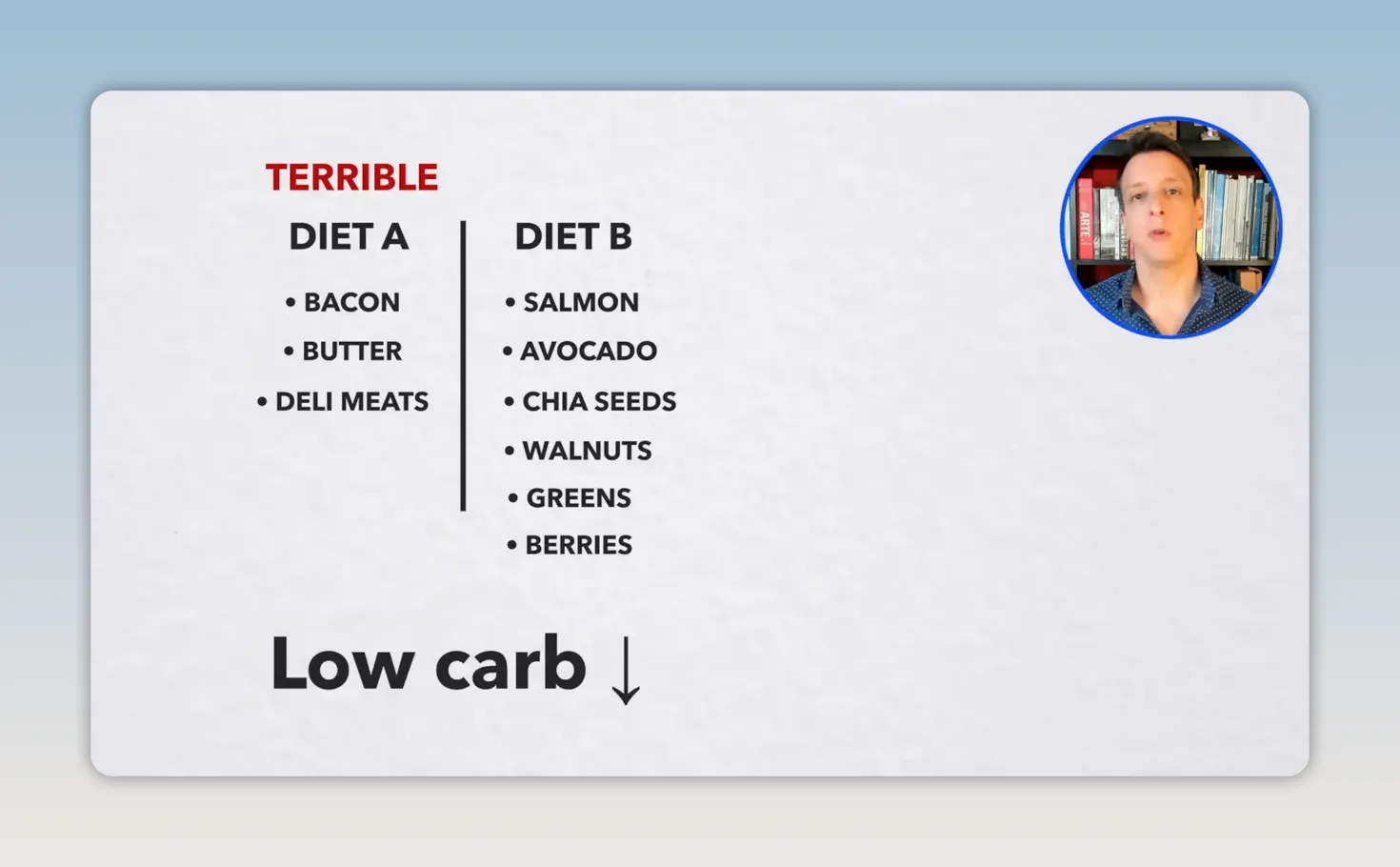
Both can be low-carb. Their nutritional quality is very different.
That is why “be careful with low-carb” is less useful than explaining what a healthy eating pattern looks like. Give people the principles, and they can adapt them to their preferences, whether they prefer fewer carbohydrates or more.
The problem is a poorly designed diet, not a carbohydrate label.
Intermittent Fasting: The Problem Is the Hype, Not a Lack of Science
I also disagree with framing intermittent fasting as a strategy whose science is not particularly sound. We have numerous randomized trials showing that intermittent fasting can help people lose weight and improve blood test results. A systematic review of intermittent fasting and weight loss provides useful background on that evidence.
The problem is the story often attached to those benefits.
Intermittent fasting gets promoted as something uniquely powerful, unlocking benefits that no other approach can deliver. The explanation often involves autophagy, mitochondrial renewal, or another impressive-sounding biological mechanism.
But a plausible mechanism is not proof of a unique health advantage. The relevant question is whether people actually do better with fasting than with a reasonable alternative.
Effective does not mean uniquely effective
Several trials have compared fasting with reducing overall food intake without fasting. When calorie intake is matched, the benefits measured in those trials are generally similar.
That does not make intermittent fasting useless. It makes it one useful option rather than a requirement.
A better message would be: fasting can be an effective strategy, but if you dislike it, there are other ways to achieve similar benefits.
I use intermittent fasting myself. Not because I think it is magic, but because it is a convenient way for me to moderate my overall calorie intake.
Whether it makes sense for you depends on how it fits your life:
- If fasting makes it easier to moderate food intake and suits your routine, it can be useful.
- If it leaves you miserable or intensely hungry, it may be a poor fit.
- If you end up overeating afterward, another approach may work better.
You do not need to force yourself into a fasting schedule because you are afraid of missing some special ancestral trigger. That is salesmanship, not a reason to ignore your own experience.
Too Much Protein? Do Not Confuse Quantity With Source
The warning about protein repeats the same mistake from a different direction.
The article supports its caution by pointing to the risks of getting too much protein from red or processed meat, including heart disease, type 2 diabetes, and certain cancers.
But that is an argument about protein sources. It does not, by itself, establish that a higher total protein intake is the problem.
Earlier, the article correctly distinguished carbohydrate quality from carbohydrate quantity. We should apply that same reasoning consistently to protein.
A higher-protein diet does not have to crowd out fiber
The article also warns about digestive consequences when people leave out fiber-rich foods such as vegetables and whole grains.
Again, that describes a poorly designed diet. It does not describe every higher-protein diet.
You can eat more protein while including plenty of vegetables, whole grains, and fiber. You can even do it without eating red or processed meat at all.
Some foods supply both protein and fiber:
- Beans
- Lentils
- Tempeh
Other protein sources, such as sardines, salmon, kefir, and unsweetened yogurt, also have favorable health evidence. They should not be treated as nutritionally equivalent to deli meats simply because all supply protein.
This is not an argument that any amount of protein is appropriate for everyone. It is an argument that the examples offered do not isolate protein quantity as the cause of harm.
The useful approach is to explain which foods make up a healthy diet, then adjust protein intake to the person. Someone who is very active or older may have different protein needs from someone else.
I do not have a blanket objection to higher-protein diets. I have an objection to poorly designed diets, whether they contain more protein or less.
Oats Are Nutritious, Despite the Internet Fearmongering
Here is another recommendation I agree with completely: oats are a nutritious food.
The human evidence is overwhelmingly favorable, with findings involving heart health, gut health, blood sugar control, lower diabetes risk, and lower mortality risk. Not every outcome comes from the same kind of study, but the overall picture is positive.
Yet on social media, calling oatmeal toxic, poisonous, or the worst possible breakfast has become almost fashionable.
Oats have turned into a useful test of whether someone forms nutrition beliefs from human evidence or from compelling internet stories. A confident declaration does not outweigh research.
Be clear about which oats we mean
I am talking about plain steel-cut oats or rolled oats, not a sugary product that happens to contain some oats.
In looking through human research, I have not found evidence supporting the sweeping claim that plain oats are harmful. That is very different from the alarming picture painted online.
Oats are one of several staples in my own diet, and we give them to the children in our family. That decision reflects the evidence, not whichever food scare is currently popular.
If you want to investigate, try searching for “oats studies” or “oats human trials.” Google Scholar is useful for a closer look. Ask what researchers actually measured in people and what they found, rather than stopping at a dramatic claim.
Warm Water Before Breakfast Is Not a Cure-All
The recommendation about warm water made me laugh a little. Apparently, drinking it before breakfast needs its own reality check now.
As nutrition fads go, this is not one I find particularly troubling. Drinking water before a meal may help suppress appetite a little. The exaggerated health claims are the issue, not the ordinary habit of drinking water.
The insistence that the water must be warm seems arbitrary. If anything, some research suggests cold water might be a little more satiating. But this is not something worth obsessing over.
If you enjoy water before a meal, fine. Warm or cold, choose what you like. Just do not expect a cure-all.
Better Nutrition Advice: Focus on Your Staples
My top nutrition advice for 2026 is the principle the article briefly gets right: stop obsessing over diet labels and pay attention to the foods you eat regularly.
Low-carb, high-carb, low-fat, high-protein. These labels can describe aspects of a diet, but they often distract from the more important question: what is actually on the plate?
Build most of your eating pattern around nutritious staples such as:
- Fruits and vegetables
- Whole grains and legumes
- Nuts and seeds
- Fatty fish
- Fermented dairy
- Lean white meats
Then adapt that foundation to your needs and preferences. Your carbohydrate intake, protein intake, and meal schedule do not have to match someone else’s for your diet to be well designed.
The label is not the meal. Teach people how to choose better foods, and we give them something far more useful than another diet to fear.
This information is educational and is not a substitute for individualized medical advice. Discuss dietary changes with a qualified health professional when medical conditions or treatment are involved.


