A popular supplement marketed for “anti-aging” has now been tested in a much larger, longer clinical trial. The results are concerning: instead of improving Parkinson’s disease symptoms, nicotinamide riboside, or NR, produced a modest worsening compared with placebo.
That needs some careful unpacking. The difference was small, and this does not mean taking an NAD supplement causes Parkinson’s disease. But it is an important reminder that a promising biological idea is not the same thing as a proven health benefit.
How did we get from exciting laboratory results to this? The progression tells us quite a bit about how to separate supplement science from supplement marketing.
Key Takeaways
- NR raised blood NAD levels but did not improve symptoms in a year-long Parkinson’s trial.
- Symptom worsening was statistically significant but smaller than the threshold considered clinically important.
- The trial does not show that NAD supplements cause Parkinson’s disease.
- Promising cellular mechanisms and short human trials do not establish long-term health benefits.
What Is NAD, and Why Try to Raise It?
Nicotinamide adenine dinucleotide, usually shortened to NAD, is a molecule we all have in our bodies. It is a coenzyme: it helps chemical reactions take place. Among its many roles, NAD is central to mitochondrial metabolism and energy production.
NAD levels naturally decline with age. Lower levels have also been reported in neurodegenerative diseases such as Alzheimer’s and Parkinson’s.
That led to a reasonable hypothesis: perhaps raising NAD levels in older people, or in people with these diseases, could improve cellular function and ultimately improve health.
It is an appealing idea. But notice the distinction: identifying a molecule that is lower in a disease does not, by itself, establish that raising it will help. That is the question experiments need to answer.
Why the Early Research Looked Exciting
Improvements in cells and animal models
Cells derived from people with Parkinson’s can show mitochondrial defects in the laboratory. In some experiments, raising NAD levels rescues some of those defects and improves cellular function.
Researchers can also create animal models of Parkinson’s. Fruit flies, for example, can be given mutations in genes that are also mutated in some people with Parkinson’s. I did a lot of this kind of work during my PhD.
These flies can develop movement problems. Studies have found that raising NAD levels can improve some of their cellular abnormalities and motor function.
Those are genuinely exciting findings. Parkinson’s has medical treatments, but no cure. A strategy that improves mitochondrial function and movement in experimental models deserves further investigation.
The next step, though, is to test whether it helps human beings. Cells in a dish and genetically modified flies cannot settle that question.
Small human trials offered preliminary encouragement
Two small randomized trials then tested NAD-raising treatment in people with early-stage Parkinson’s disease. Both lasted about a month and enrolled only a few dozen participants.
Rather than administering NAD itself, these studies used nicotinamide riboside, or NR, a precursor the body can use to make NAD. Direct NAD administration is not a reliable way to assume NAD will rise where it is needed, which is one reason researchers study precursors.
Both the initial randomized trial and a second short-term trial found that NR raised NAD levels. There were also suggestions of symptom improvement, at least in subsets of participants.
NR was compared with a placebo, a dummy pill without the active agent. Participants did not know which treatment they were receiving, helping reduce the influence of expectations.
This is an appropriate way to begin human testing. Small, short trials are useful for looking at initial safety and identifying signals worth pursuing. NR appeared reasonably safe over those brief periods.
What those trials could not establish was whether NR meaningfully improves disease outcomes over time. A month-long study involving a few dozen people is not the final test of either benefit or safety.
The Larger NR Trial: More People, Much Longer Follow-Up
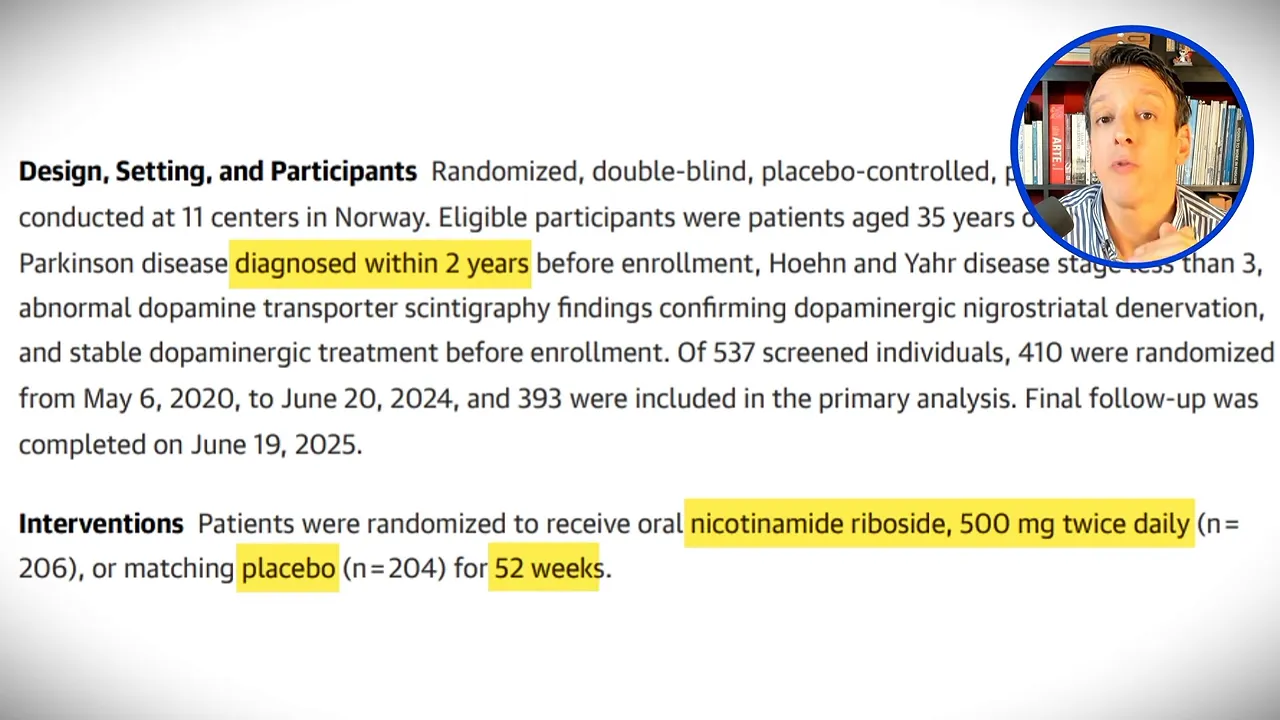
The newly reported NOPARK randomized clinical trial was a substantial step up in scale.
- Participants: About 400 people with early-stage Parkinson’s, diagnosed less than two years before enrollment.
- Treatment: NR at 1 gram per day, given as two 500-milligram doses, or placebo.
- Duration: One year, rather than about one month.
- Design: Randomized, double-blind, and placebo-controlled.
Randomization assigned participants to the treatment groups. Double-blinding meant that neither participants nor the investigators interacting directly with them knew who was receiving NR and who was receiving placebo. These features help reduce several important sources of bias.
Once again, NR raised NAD levels, at least in participants’ blood. What happened to NAD levels in the brain was less clear.
That distinction matters. Raising a blood measurement establishes a biological effect. It does not automatically establish that the treatment reaches the relevant tissue, improves its function, or helps the person taking it.
What Happened to Parkinson’s Symptoms?
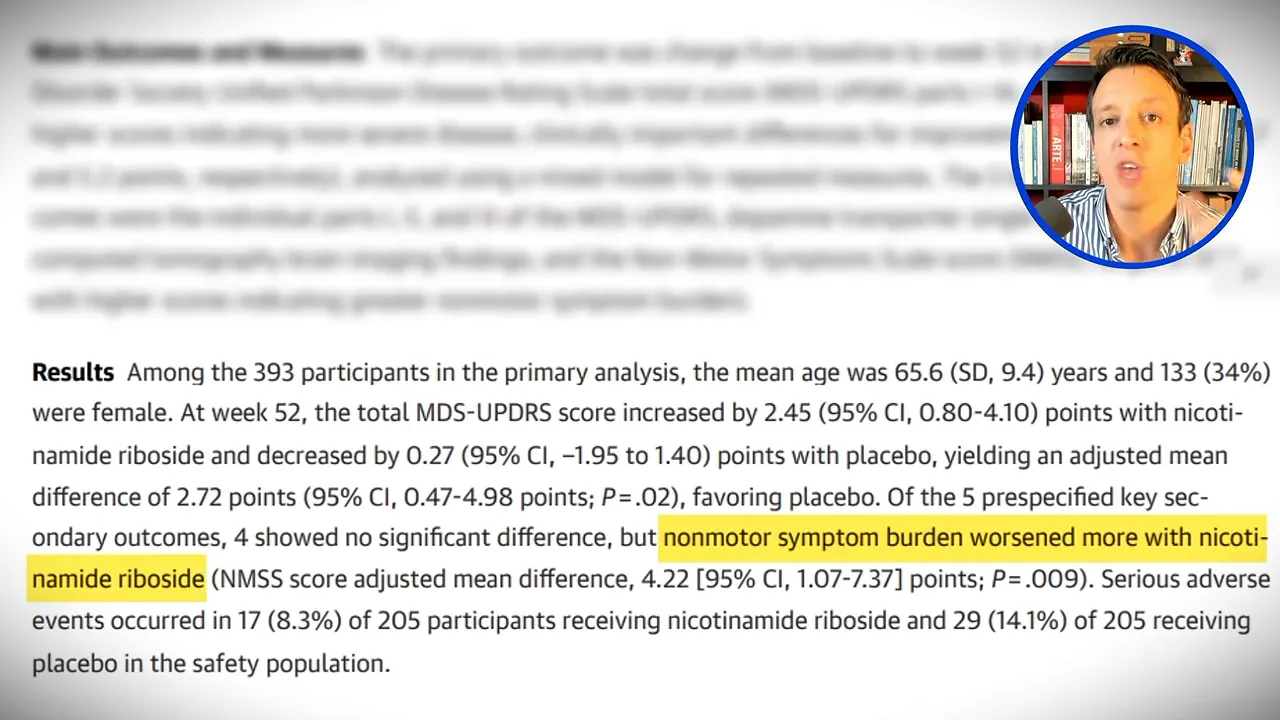
The trial used a scale that captures overall Parkinson’s disease symptoms. From the beginning to the end of the year, the placebo group’s overall score was essentially unchanged. The NR group’s score worsened slightly.
The difference was statistically significant, but below the threshold considered clinically important.
Those two points belong together. Statistical significance addresses the evidence for a difference between the groups. Clinical importance addresses whether the size of that difference is large enough to be considered meaningful in practice.
So this was not a large deterioration. But it was also not the improvement researchers had hoped to find. The direction of the result was unfavorable.
Non-motor symptoms also worsened as a group
Parkinson’s affects more than movement. It can also involve mood, attention, memory, and fatigue.
When researchers examined non-motor symptoms collectively, those also worsened in the NR group compared with placebo. That does not mean every individual symptom worsened in every participant. It describes the result for that symptom category as a whole.
The reason is not understood. Perhaps NR or the resulting changes in NAD interact with Parkinson’s medications. Perhaps there is another effect on the nervous system. These are possibilities to investigate, not established explanations.
What This Study Does Not Show
It is important not to replace supplement hype with exaggerated alarm. This trial has a specific scope.
- It does not show that NAD supplements cause Parkinson’s. Participants already had the disease when they entered the study.
- It does not show a large worsening of symptoms. The observed difference was modest and below the threshold considered clinically important.
- It does not settle every possible use of NR. Other diseases and people without Parkinson’s need to be studied in their own right.
- It does not test every product sold as an NAD booster. The intervention here was NR at a particular dose in a particular population.
Future research may identify contexts in which NR is beneficial. That remains possible. But a possible future benefit is not evidence of a benefit today.
The Bigger Lesson for Anti-Aging Supplements
NR is widely sold over the counter, often with little medical supervision. It is a multimillion-dollar supplement business, and much of the enthusiasm has been built on cellular experiments, animal studies, and preliminary human trials.
Those forms of research have real value. They tell scientists what might be worth testing next. They do not, on their own, justify selling a pill as a health solution or taking it in the expectation of living longer or avoiding disease.
The progression here is exactly why science moves carefully:
- Identify a plausible biological mechanism.
- Test it in cells and animal models.
- Conduct small human trials to assess initial safety and feasibility.
- Run larger, longer trials to find out what happens to health outcomes.
A promising finding at one step is not a guarantee of success at the next. Even encouraging early human results often fail to hold up under more rigorous testing.
Raising NAD is not the same as improving health. In this trial, the blood marker moved in the intended direction, while symptoms moved slightly in the wrong direction.
That is the practical lesson: distinguish evidence that a supplement changes something in the body from evidence that it actually helps. Exciting mechanisms deserve research. Health claims need clinical results.
This information is educational and is not a substitute for medical advice, diagnosis, or treatment. Discuss supplements and questions about Parkinson’s care with your physician or another qualified health professional.


