A new randomized trial compared a ketogenic diet with a Mediterranean diet, and the differences were striking. Despite similar weight loss, the keto group lost more liver fat, had a larger improvement in liver insulin resistance, and had a higher rate of prediabetes remission.
That is interesting. But before we declare a winner in the diet wars, there is a crucial question: Was it the carbohydrate restriction, the extra protein, or something about the people studied?
The results deserve our attention. They also deserve a closer look, because this study does not line up neatly with some previous research.
Key Takeaways
- All three diets improved metabolic health, but keto produced larger liver-fat reductions despite similar weight loss.
- Higher protein intake in the keto group complicates attributing the extra benefits to carbohydrate restriction.
- The small trial’s results need to be considered alongside earlier research showing similar outcomes across carbohydrate intakes.
- Long-term dietary choices need to account for sustainability and individual blood-work responses.
What Did the Study Actually Compare?
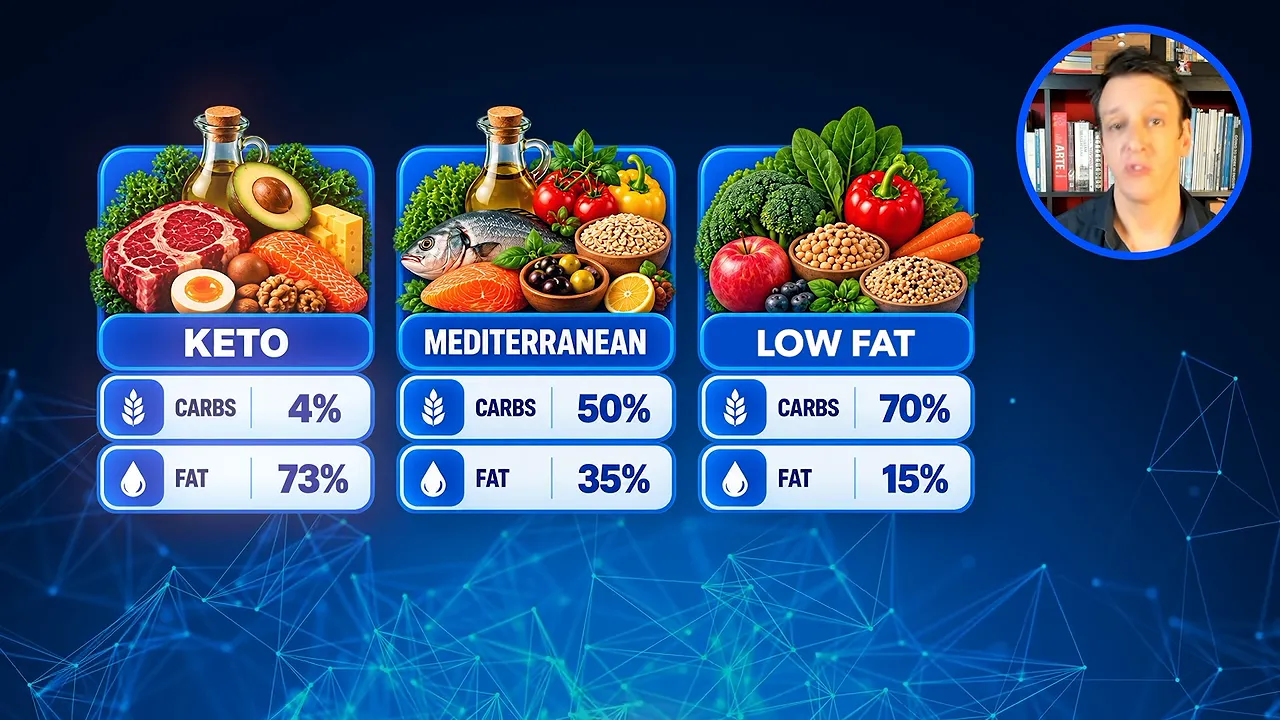
The new clinical trial enrolled people with obesity, prediabetes, and fatty liver. Researchers randomly assigned them to one of three diets:
- Ketogenic diet: 4% of calories from carbohydrates, 73% from fat, and 23% from protein.
- Traditional Mediterranean diet: 50% of calories from carbohydrates, 35% from fat, and 15% from protein.
- Low-fat, plant-forward diet: 70% of calories from carbohydrates, 15% from fat, and 15% from protein.
The Mediterranean diet included familiar staples: fruits, vegetables, fish, some white meat, olive oil, nuts, seeds, and whole grains such as oats.
The low-fat diet featured a fairly similar collection of foods, but with more carbohydrate and less fat. It was plant-rich, not completely vegan.
Another strength of the trial was that researchers provided prepackaged meals and delivered them to participants’ homes. That helps people follow the assigned diets, rather than leaving the entire intervention to dietary advice.
The important twist: weight loss was matched
Initially, researchers reduced calories, and participants in all three groups started losing weight. Once they had lost about 10% to 11% of their body weight, the researchers adjusted their food intake to stabilize their weight.
Why does that matter? Because weight loss itself can improve liver fat and blood sugar. If one group loses much more weight, it becomes difficult to tell whether a better outcome comes from the diet’s composition or simply from losing more weight.
Here, the groups lost similar amounts of weight by design. That makes it possible to look for effects beyond the amount of weight lost. It does not, however, tell us which individual feature of the diets caused those differences.
The Results: Similar Weight Loss, Different Metabolic Changes
After about five months, all three groups had lost similar amounts of total body fat. What happened inside their livers was a different story.
Liver fat fell more on keto
All three diets reduced liver fat, which is worth emphasizing. These participants started with fatty liver, and every dietary approach produced improvement.
- Mediterranean diet: approximately 45% reduction in liver fat.
- Low-fat diet: approximately 45% reduction in liver fat.
- Ketogenic diet: approximately 68% reduction in liver fat.
A 45% reduction is substantial. A 68% reduction, with similar weight loss, raises an important scientific question about what else was contributing.
Insulin resistance improved differently in muscle and liver
The insulin-resistance findings were tissue-specific. In other words, the answer depended on which part of the body researchers examined.
Muscle insulin resistance improved by about the same amount on all three diets. Liver insulin resistance also improved in every group, but the improvement on keto was roughly two to three times greater than on the other diets.
That distinction matters. Saying a diet “improves insulin resistance” can hide meaningful differences between what is happening in muscle and what is happening in the liver.
Fasting blood sugar and prediabetes remission
Fasting glucose, or fasting blood sugar, improved across the board. The Mediterranean and low-fat groups had a drop of about six points, compared with about 12 points in the keto group.
By the end of the trial, the percentage of participants who no longer met the criteria for prediabetes was:
- Low-fat: 7%.
- Mediterranean: 29%.
- Keto: 50%.
This is called remission. People sometimes describe it as “reversing” prediabetes, but the precise finding is that these participants no longer met the criteria at the end of the study. It is not a guarantee about their future health.
Some inflammatory markers also decreased more in the keto group.
What Happened to ApoB?
ApoB, a blood marker used to assess cardiovascular risk, decreased on all three diets:
- Low-fat: a nine-point decrease.
- Mediterranean: a 15-point decrease.
- Keto: a six-point decrease.
But here is the important part: the differences between groups were not statistically significant. We cannot conclude from this trial that one diet was more effective at lowering apoB than another. The numerical ranking alone is not enough.
This may sound surprising, especially given the version of keto used. It was not exclusively an avocado-and-walnut approach. The diet included fatty fish, nuts, and seeds, but also plenty of bacon, sausage, and red meat.
One possible explanation is that the weight-loss intervention reduced or obscured differences related to the foods and macronutrients themselves. That is a possibility, not an established explanation.
The practical principle is to pay attention to your own blood work. A diet label does not tell you how your apoB, blood sugar, or other relevant markers are responding.
Why These Findings Challenge Earlier Research
This is usually where the diet arguments start. One camp dismisses an inconvenient study; another treats a favorable study as proof that further research was never necessary.
I find it more productive, and frankly more relaxing, to let the evidence shape our beliefs.
Many previous trials suggested that once calories and weight loss were accounted for, differences in carbohydrate and fat intake did not make much difference to liver fat or fasting glucose.
For example, a 2022 randomized trial compared diets providing about 40% versus 10% of calories from carbohydrates. That is a fourfold difference in carbohydrate intake. Yet with calories and weight loss matched, the reductions in liver fat were essentially identical.
The new study suggests something additional may be happening beyond weight loss. Calories and weight loss still matter: all three groups improved. But the keto group appeared to receive an extra benefit.
The scale may therefore miss important metabolic differences. Two people can lose the same amount of body weight while experiencing different changes in liver fat and glucose regulation.
Still, science does not work by selecting one trial and pretending the others do not exist. We need explanations that can account for the full body of evidence.
Neither trial is perfect
The new trial was small, with roughly 14 participants per diet. That is a reason to be cautious before drawing sweeping conclusions, particularly from the remission percentages.
The 2022 trial was larger at a comparable follow-up point, with approximately 20 to 30 participants per diet around six months. However, it began with about 200 participants overall and experienced substantial dropout. That is a limitation too.
There is no such thing as a perfect trial. The task is to weigh the strengths and weaknesses, not use imperfections as an excuse to discard whichever result we dislike.
Three Possible Explanations for Keto’s Advantage
1. Very low carbohydrate intake might cross an important threshold
The most obvious explanation is carbohydrate restriction itself, but perhaps the relationship is not a simple straight line.
Going from 40% to 10% of calories from carbohydrates might produce little additional change in liver fat when weight loss is matched. Going below 10%, into a more severely carbohydrate-restricted ketogenic range, might trigger an additional effect.
One possibility involves total insulin exposure over 24 hours and the effects of hormonal changes on liver metabolism.
That could help explain why the earlier trial found similar results while this one found a difference. But it remains a hypothesis, not something this trial established.
2. The benefit might depend on the population
Both studies included people with obesity, but the new trial specifically required participants to have prediabetes. The earlier trial did not have that inclusion criterion.
Perhaps people with this particular combination of metabolic problems respond especially well to very low carbohydrate intake. If so, the findings might not apply in the same way to other populations.
A diet can be particularly useful for one group without being universally superior. Who was studied is part of the result, not a minor detail.
3. The extra protein might explain some of the difference
This is a particularly intriguing possibility because it is easy to overlook.
When we describe diets as “low-carb” or “low-fat,” we tend to picture one variable changing. In reality, several things change at once. Your body responds to those physiological changes, not to the name of the diet.
In the new trial, the keto group received 23% of calories from protein, compared with 15% in both other groups. In the 2022 trial, protein intake was matched across the higher- and lower-carbohydrate diets.
So perhaps the additional benefit was not entirely about removing carbohydrate. Perhaps it was partly, or substantially, about adding protein.
This is a real possibility because previous research on protein and liver fat has shown that increasing dietary protein can produce greater liver-fat loss even when calories are matched.
If protein explains the difference, it could open up more dietary options. A Mediterranean or higher-carbohydrate pattern with an appropriate protein intake might provide similar benefits. That is a testable possibility, not yet a demonstrated conclusion.
How could researchers test it?
The next experiment is fairly straightforward: compare ketogenic and Mediterranean diets while matching protein intake as well as weight loss.
- If protein explains the advantage, matching protein should remove or substantially reduce the differences.
- If carbohydrate restriction explains the advantage independently of protein, the keto group should retain an extra benefit.
That comparison would tell us much more about which part of the dietary package is doing the work.
What This Means for Choosing a Diet
Two main lessons stand out.
First, all three diets improved metabolic health in this trial. The very low-carbohydrate, higher-protein diet produced larger improvements in several liver-related and glucose-related measures, at least in this small group of people with obesity, prediabetes, and fatty liver.
That is promising evidence. It is not proof that keto is the best diet for everyone, and it does not resolve whether carbohydrate restriction or extra protein deserves the credit.
Second, sustainability remains central. A diet can look excellent in a clinical trial and still do little for you if you cannot maintain it. The best long-term approach needs to deliver measurable improvements and be something you can actually keep eating.
Food is not the whole picture, either. Beverage choices can also influence liver fat, sometimes even when calories are matched. They deserve attention alongside the composition of your meals.
The useful response to this research is neither dismissal nor a victory lap. It is curiosity: take the findings seriously, keep the limitations in view, monitor your response, and build an eating pattern that works for your health over the long term.
This information is educational and is not a substitute for medical advice, diagnosis, or treatment. Discuss dietary changes and the interpretation of your blood tests with a qualified healthcare professional.


