For the right person, drugs like Ozempic can be life-changing. Some people describe finally getting relief from persistent hunger and food cravings. But no medication is for everyone, which raises an interesting question: can simple, inexpensive foods help us achieve some of those same goals?
There is useful research here. Unfortunately, much of the advice about foods that “mimic Ozempic” starts with a shaky assumption: if a food raises GLP-1, it must help you feel full and lose weight.
A temporary rise in a hormone is not the same thing as a lasting effect on appetite or body weight. The more useful question is which foods and preparation methods actually help people feel satisfied, eat less, or lose fat in human studies. That takes us beyond GLP-1 to food texture, vinegar, beta-glucan, chili peppers, and protein.
Key Takeaways
- A food-induced rise in GLP-1 does not establish lasting fullness or meaningful weight loss.
- More intact food textures can increase fullness and reduce subsequent food intake.
- Protein, pulses, oats, and barley offer practical ways to build more satisfying meals.
- Vinegar and chili peppers show promising results, but the evidence does not justify miracle claims.
Table of Contents
- Why Raising GLP-1 Is Not the Same as Taking Ozempic
- 1. Food Texture: The Overlooked Factor in Fullness
- 2. Vinegar: Promising Human Results, With Important Limits
- 3. Beta-Glucan: A Fiber That Can Slow Stomach Emptying
- 4. Chili Peppers: Small Effects, Not a Weight Loss Shortcut
- 5. Protein: Work With Several Appetite Signals at Once
- Put the Foods Together, Rather Than Chasing One “GLP-1 Booster”
Why Raising GLP-1 Is Not the Same as Taking Ozempic
GLP-1 is a hormone your body produces after eating. Among its functions, it helps signal fullness. Ozempic was developed by harnessing this existing biological system, not by inventing an entirely new one.
But there is a crucial difference. Natural GLP-1 is broken down very quickly, with a half-life of roughly one to two minutes. The molecule used in Ozempic was modified to resist that breakdown and has a half-life of about a week.

That difference is central to how the drug works. Simply showing that a food raises GLP-1 shortly after a meal does not establish that it will keep you full longer or produce meaningful weight loss.
Instead of chasing a particular hormone reading, we can look for outcomes that matter:
- Does the food reduce hunger or increase fullness?
- Do people actually eat less afterward?
- Do randomized trials show changes in body weight, fat mass, or waist circumference?
A food does not need to raise GLP-1 to be useful. And raising GLP-1 does not automatically make it useful.
1. Food Texture: The Overlooked Factor in Fullness
Imagine two meals with the same ingredients and the same calories. One is soft and mushy. The other requires more chewing.
That difference alone can affect how satisfied you feel and how much you eat. Research on food texture and satiation, including a randomized trial of texture-based eating rate, suggests that the physical structure of food deserves more attention.
Apple slices, applesauce, and juice are not interchangeable
One particularly careful apple study compared equal-calorie portions of apple slices and applesauce. The researchers made the applesauce from the same batch of apples and peeled the slices so the fiber amounts matched.
Despite those similarities, participants reported feeling fuller after the apple slices.
Fifteen minutes later, participants were offered the same meal. The slices also led to lower subsequent food intake, with an overall calorie reduction of about 15% reported in the experiment. Apple juice was less filling than either slices or applesauce, and participants ate the most afterward.
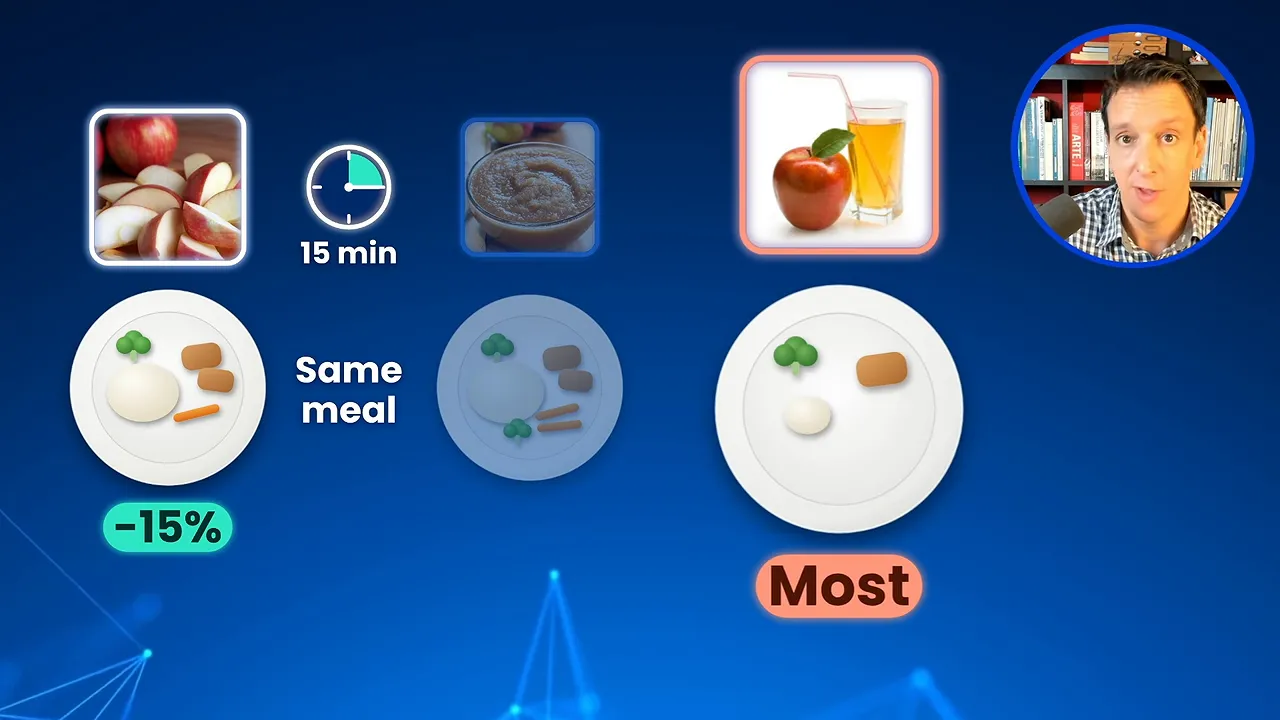
The researchers also tested adding fiber to the juice. That did not make much difference. In this experiment, the food’s form appeared to matter beyond its total fiber content.
Why? Chewing may contribute. So may the work required to break down a more intact food during digestion. The precise explanation is not settled by this experiment, but the practical lesson is useful: how you prepare a food can influence how filling it is.
Simple ways to keep more structure in your meals
Often, this means doing less work in the kitchen, not more:
- Leave potatoes unmashed. Try plain boiled potatoes rather than automatically turning them into a mash.
- Keep vegetables whole or chunky. You do not always need to puree them.
- Give oats some texture. Choose steel-cut or rolled oats and cook them without reducing everything to complete mush. Fruit and nuts can add more pieces to chew.
- Choose intact pieces of meat or chicken. These generally require more chewing than ground meat or nuggets.
- Try a raw carrot as a snack. It takes longer to eat than very soft, boiled carrots.
- Eat whole fruit more often. If fullness is the goal, chewing a piece of fruit may work better than drinking it in a smoothie or juice.
- Keep edible peels when practical. Apples and pears are good candidates. Pineapples, please peel.
This does not mean smoothies are unhealthy. It means a nutritious food can still be less filling in one form than another. If you are trying to trim down, that distinction can matter.
Plain boiled potatoes are especially interesting. In a classic satiety study comparing 38 foods, researchers served equal-calorie portions and measured fullness. Boiled potatoes received the highest satiety score.
Those scores are averages, not promises about every individual. Still, they challenge the idea that potatoes are inherently a poor choice for weight management.
Pay attention to foods that are easy to eat quickly
The opposite combination can be particularly easy to overconsume: lots of calories with very little chewing.
Think of ice cream, jelly, jam, soda, pudding, very soft white bread, cupcakes, and soft cookies. Some are calorie-dense; others deliver calories in liquid form. They can go down quickly, sometimes with surprisingly little awareness of how much you have eaten.
The goal is not to make every meal a chewing contest. It is to use food structure to slow eating naturally while keeping foods you enjoy. Less blending, less mashing, and less processing can sometimes mean less effort for you, too.
2. Vinegar: Promising Human Results, With Important Limits
Vinegar is interesting for a different reason. Its main active compound, acetic acid, may influence fat metabolism through a pathway involving an enzyme called AMPK.
In laboratory experiments, liver cells metabolize acetic acid in a way that can activate AMPK. This can promote proteins involved in breaking down fat while inhibiting proteins involved in making new fat.
Interesting biochemistry. But the question is always the same: does it translate into a meaningful effect in people?
What the apple cider vinegar trial found
In a small randomized trial of apple cider vinegar, both groups were prescribed a diet with a daily calorie reduction of about 250 calories. One group also received 15 milliliters, roughly one tablespoon, of apple cider vinegar at lunch and another tablespoon at dinner.
That was two tablespoons per day for 12 weeks.
The vinegar group reported lower appetite scores, both compared with the control group and compared with their own starting scores. That is notable because reducing calorie intake often makes people hungrier, not less hungry.
By the end of the trial:
- The vinegar group lost approximately 4 kilograms on average.
- The control group lost approximately 2.3 kilograms.
- BMI fell more in the vinegar group.
- An index estimating visceral adiposity decreased significantly in the vinegar group, while the control group did not show a significant change in that measure.
Visceral fat is the fat around internal organs that is particularly relevant to metabolic health. An estimated index is not the same as directly measuring that fat, but the result is worth investigating further.
What we should not conclude
This trial involved only about 40 participants and lasted three months, not years. It does not establish vinegar as a stand-alone weight loss treatment, nor does it prove that the proposed AMPK mechanism explains the human results.
I would not expect a miracle from vinegar alone. If you enjoy it, using some with meals may be a reasonable addition to a broader food strategy. A lentil salad with vinegar is a much more sensible interpretation than treating vinegar as a magic solution.
Would other vinegars work? Possibly. If acetic acid is responsible, there is a plausible reason to expect similar effects from other varieties. But this particular trial used apple cider vinegar, so we cannot assume that all vinegars have been shown to produce the same result.
3. Beta-Glucan: A Fiber That Can Slow Stomach Emptying
One of Ozempic’s effects, especially early in treatment, is slowing gastric emptying. That is the rate at which food moves from the stomach into the intestine.
When food stays in the stomach longer, the stomach wall remains stretched. That stretch helps send fullness signals through the nervous system. In everyday terms, your gut is telling your brain that there is still food to process.
One dietary component that can also slow gastric emptying is beta-glucan.
Beta-glucan is a viscous fiber. Mixed with water, it forms a thick, gel-like substance. Oats and barley are particularly useful dietary sources.
Again, a plausible mechanism is not enough by itself. But research reviewing oat interventions includes randomized trials showing reductions in body weight and adiposity in people with overweight.
Oatmeal also ranked third for satiety in the 38-food study, behind boiled potatoes and a food we will get to shortly.
This gives oats more than one potential advantage: their fiber can influence digestion, and keeping some of their structure can make them slower to eat. Barley offers another way to bring beta-glucan into meals without having to eat oatmeal every day.
4. Chili Peppers: Small Effects, Not a Weight Loss Shortcut
Capsaicinoids are the compounds that give chili peppers their heat. Capsaicin is the best-known example.
These compounds bind to receptors in the body and can influence appetite-related signaling, including GLP-1 and other hormones such as CCK and PYY. But, once again, the important question is what happens when people actually consume them.
Studies giving capsaicinoids before meals have found modest reductions in food intake. A meta-analysis of randomized capsaicin trials also found reductions in body weight, BMI, and waist circumference.
The average weight difference was about half a kilogram over studies lasting one to three months. That is a modest effect, not a transformation.
What about gochujang?
Randomized trials have also tested gochujang, a Korean fermented red pepper paste. Across these trials, researchers reported improvements in measures including visceral fat, apoB, and triglycerides compared with placebo.
One gochujang trial is particularly relevant to the visceral fat question. But there is an attribution problem: the paste is not pure chili pepper. It contains other ingredients, including fermented soybeans.
We cannot jump from “this paste had an effect” to “capsaicin caused the effect.”
I would put chili peppers lower on the confidence list than several of the other strategies here. The effects appear smaller, and personal preference matters enormously. If you enjoy spicy food, it may be worth including. If you hate the heat, there is no need to force it.
5. Protein: Work With Several Appetite Signals at Once
Protein kept appearing in the research as a consistent contributor to fullness.
Yes, protein can raise GLP-1. But that is not the main reason to pay attention to it. Protein also affects other appetite-related hormones, including ghrelin and CCK. It is a good example of why a useful food strategy does not need to depend on one molecule or one pathway.
A meta-analysis of randomized protein trials found that consuming protein reduced short-term hunger and increased fullness. Longer-term protein interventions also showed modest benefits for weight loss.
And the food that ranked second in that classic satiety study? Lean fish. A protein-rich food, sitting between boiled potatoes and oatmeal.
Practical breakfast options
Instead of centering breakfast on sugary refined cereals, try a combination that offers protein and more intact food structure:
- Unsweetened Greek yogurt with berries and nuts. This adds protein alongside fruit and texture.
- One or two eggs with vegetables and whole grain toast. A simple option with several different food components.
- Steel-cut or rolled oats with Greek yogurt, fruit, and nuts. Choose these rather than instant oats with added sugar, and retain some texture when cooking.
The oatmeal combination is particularly useful for illustrating the bigger idea. You are bringing together protein, relatively intact food structure, and beta-glucan in one meal. You do not have to bet everything on a single hormonal effect.
Beans, lentils, and chickpeas deserve special attention
Pulses are among my favorite protein sources because they also bring fiber and food volume to the meal, and they are inexpensive.
A systematic review of pulses and satiety found greater fullness after meals containing pulses. A separate meta-analysis of non-soy legume trials reported reductions in body weight, waist circumference, and fat mass, with the pooled fat-mass reduction around 2 kilograms.
That does not mean adding a few beans guarantees a 2-kilogram fat loss. These are averages across interventions, not a personal forecast. And it certainly does not mean beans produce the same results as Ozempic.
Still, a meaningful improvement from an affordable, nutritious food is worth taking seriously. Modest changes matter when they can be maintained.
Put the Foods Together, Rather Than Chasing One “GLP-1 Booster”
The most practical approach is to combine several of these ideas in meals you actually enjoy.
- Add lentils to a salad. Include vinegar if you like the flavor.
- Build a chickpea and barley bowl. This combines pulse protein and fiber with a source of beta-glucan.
- Serve beans with chunky vegetables. Add chili peppers if heat is your thing.
- Make lentil soup. It is another straightforward way to include pulses. I personally find it delicious.
These meals bring together protein, fiber, and substantial food volume without necessarily packing in a lot of calories. Depending on the ingredients and preparation, they can also provide beta-glucan, more chewing, and capsaicinoids.
The goal is not to turn food into a drug. It is to make satisfying eating easier. Foods that briefly raise GLP-1 are not equivalent to a long-acting medication. But human research does support several ordinary food choices that can help with fullness and, in some cases, produce modest improvements in weight or body fat.
Keep more structure in your food. Include protein and pulses. Make use of oats or barley. Treat vinegar and chili peppers as optional additions with promising but limited evidence, not as the foundation of a weight loss plan.
That is a more useful strategy than building a shopping list around one hormone.
This information is educational and is not a substitute for individualized medical advice, diagnosis, or treatment. Discuss medication and weight-management decisions with a qualified healthcare professional.


