A hugely popular podcast can deliver a fascinating conversation and still be a terrible source of health advice. Those are not mutually exclusive.
The Diary of a CEO has almost 20 million YouTube subscribers at the time of this investigation, and health is central to its success. More than half of its 50 most popular episodes address some aspect of health. That gives its medical and nutrition claims enormous reach, and makes their accuracy consequential.
After examining examples involving cancer, fiber, heart disease, statins, sodium, fruit, and blood sugar, my assessment is blunt: much of the health information is shockingly poor. In several cases, the evidence points in the opposite direction from what a guest confidently presents.
But the most revealing part is not simply that guests get things wrong. The podcast’s own research documents sometimes directly contradict the central claims it broadcasts. Meanwhile, product promotions and referral-tracking links raise another question: how do commercial incentives interact with those claims?
Key Takeaways
- Some of the podcast’s own research documents directly contradict its guests’ central health claims.
- Preclinical cancer research does not establish ketogenic diets as a universal or proven cancer treatment.
- Written and on-screen corrections can leave audio-only listeners without essential scientific context.
- Product promotions and referral tracking raise conflict-of-interest questions that deserve scrutiny alongside the health claims.
Table of Contents
- Cancer and Ketogenic Diets: A Hypothesis Is Not a Proven Treatment
- Fiber: Ketones Do Not Replace What Happens in Your Colon
- Heart Disease: Persistent Problems Do Not Erase Major Progress
- The Appeal of “They’re Lying to You”
- The Podcast’s Own Fact Checks Contradict Its Guests
- Why PDFs and On-Screen Notes Are Not Enough
- Better Fact-Checking Does Not Require Censorship
- Blood Sugar Fear Becomes a Supplement Sales Pitch
- Referral Links and the Conflict-of-Interest Problem
- The Bigger Problem: Accuracy Competing With Virality
Cancer and Ketogenic Diets: A Hypothesis Is Not a Proven Treatment
One of the podcast’s most popular guests, a professor from Boston College, presents a sweeping explanation of cancer and a dietary strategy for managing it.
The argument goes roughly like this: cancer cells depend on glucose and glutamine, so restricting those fuels while shifting the body toward fatty acids and ketones offers a way to control cancer without the toxicity of conventional treatment.
It sounds straightforward. The biology is not.
Different tumors can use different fuels
There is evidence that some tumors can use fatty acids and even ketones. Some preclinical research has reported that ketogenic diets can promote tumor spread in particular cancer models.
That needs an immediate qualification. These findings do not establish that ketogenic diets promote cancer in people generally. Much of this research involves cells, animals, and limited patient observations. The same caution applies to claims of benefit.
Neither a promising laboratory result nor a concerning animal result is a substitute for robust clinical trials.
The evidence discussed here suggests a tumor-dependent picture:
- Restricting carbohydrate or inducing ketosis might eventually prove useful for some cancers.
- It may have little or no effect on others.
- In some experimental models, it may support tumor growth or spread.
That is a reason to investigate carefully, not to announce that we have already solved cancer. The research on ketogenic diets and cancer needs to be interpreted with attention to the tumor, experimental setting, and strength of evidence.
Cancer does not universally mean broken mitochondria
A second pillar of the professor’s argument is that all cancers originate in defective mitochondria that cannot generate energy properly through respiration.
But many cancers retain functional mitochondria. Some depend on mitochondrial respiration for growth and survival. A review of mitochondrial function in cancer describes the importance of oxidative phosphorylation, part of mitochondrial energy production, in tumor development. Cancer cells can even exhibit increased mitochondrial ATP production.
In other words, cancer metabolism is not one universal malfunction with one universal dietary fix.
Could aspects of these metabolic theories eventually help treat particular cancers? Hopefully. That possibility deserves research. Presenting them as clinically established and applicable to essentially every cancer is another matter entirely.
The stakes are not academic. A person with cancer, or a desperate family member, could interpret an interview that disparages chemotherapy and radiation as permission to replace treatment with a ketogenic diet. The evidence presented does not justify that decision. Dietary changes during cancer treatment should be discussed with the treating oncology team, not used as a reason to abandon care.
Fiber: Ketones Do Not Replace What Happens in Your Colon
Another episode features a psychiatrist arguing that dietary fiber is unnecessary because a ketogenic diet produces beta-hydroxybutyrate, which can supposedly substitute for the butyrate produced when gut bacteria ferment fiber.
This confuses related-sounding molecules with interchangeable biological functions.
Ketone bodies are produced by the liver and circulate in the blood. Short-chain fatty acids produced through bacterial fermentation arise inside the gut, particularly the colon. Where a molecule is produced and acts matters.
Many short-chain fatty acid functions occur locally, inside the large intestine. They help regulate intestinal pH, which can discourage pathogens such as Clostridioides difficile, and interact with receptors on cells facing the intestinal lumen.
Those local effects are not automatically reproduced by a different molecule arriving through the bloodstream.
There is another problem: butyrate is only one member of a family. Acetate and propionate are also short-chain fatty acids. Even if circulating beta-hydroxybutyrate reproduced every action of butyrate in the gut, which it does not, that would still not replace all the effects of fiber and its fermentation products.
This review of short-chain fatty acid receptors and intestinal physiology provides useful background on why these distinctions matter.
The public-health context makes the claim particularly troubling. Western populations already consume far too little fiber. Lower fiber intake is associated with higher risks of heart disease, diabetes, cancer, and mortality. Encouraging people to eat even less requires much stronger reasoning than a superficial comparison between butyrate and beta-hydroxybutyrate.
Heart Disease: Persistent Problems Do Not Erase Major Progress
In another interview, a cardiovascular surgeon argues that decades of advice about cholesterol and the development of cholesterol-lowering drugs have failed because heart disease is getting worse.
That claim needs a reality check.
The ischemic heart disease prevalence series examined for this investigation shows a substantial decline since 1990, approaching half its earlier level. Separately, the American Heart Association reports major long-term reductions in U.S. death rates: overall heart disease mortality fell by roughly 66% over five decades, while heart attack mortality declined by nearly 90%.
Those are extraordinary improvements. They do not mean every cardiovascular condition has improved, that every population has benefited equally, or that heart disease is no longer a major killer. They also do not establish how much of the improvement came from any one intervention.
But they certainly undermine the blanket claim that nothing is working and everything is simply getting worse.
We should preserve the gains, identify the remaining problems, and improve further. Misrepresenting the starting point does not help.
The misleading claim that statins add only four days of life
Cardiologist Dr. Aseem Malhotra offers another striking claim: taking a statin after a heart attack adds only about 4.2 days of life over a five-year period.
The key phrase is over a five-year period.
The analysis behind that talking point did not follow everyone until death and then determine their total lifetime extension. It calculated an average survival gain within the trials’ limited follow-up periods. Most participants were still alive when follow-up ended.
I contacted the study’s authors previously to clarify the method, and they confirmed that living participants were included in that average.
A survival difference measured during a short observation window is not the same thing as the total additional lifespan a treatment might provide. Presenting the former as the latter makes the result sound far less meaningful than it is.
The potential benefit of a statin depends heavily on baseline cardiovascular risk. A person with extremely low risk has little risk for a drug to reduce. A person at high risk can benefit substantially more. Some analyses estimate years of additional life, reaching around nine years in particular high-risk scenarios. That is not a promise to every patient, either.
We absolutely should discuss genuine adverse effects, limitations, and trade-offs. But that discussion requires an honest account of what a study measured.
This is not harmless rhetoric. Research on negative statin news has linked such coverage with treatment discontinuation and subsequent increases in heart attacks and cardiovascular deaths.
The Appeal of “They’re Lying to You”
Not every health episode on The Diary of a CEO is poor. I found worthwhile exceptions, including its conversations with Professor Sarah Berry and Dr. Mike. Those deserve acknowledgment.
But a few strong episodes do not make the overall selection reliable.
The titles reveal a recurring formula: somebody is supposedly lying to you about healthy food, weight loss, running, menopause, sunlight, honey, or some other topic. The same framing extends well beyond health, even to pyramids and Antarctica.
Who, exactly, is doing all this lying? Often that remains conveniently vague.
The formula sells a feeling: ordinary advice is wrong, powerful people are hiding the truth, and this conversation will finally reveal it. A contrarian claim can be correct, of course. But being surprising is not evidence.
There is also a familiar credibility trick in wellness content. A guest offers sensible advice about exercise, smoking, body weight, and limiting junk food. That establishes trust. Then unsupported claims arrive wrapped in the credibility of the reasonable ones.
The sensible recommendations do not validate everything that follows.
The Podcast’s Own Fact Checks Contradict Its Guests
In 2025, the podcast began linking research PDFs to some episodes. These documents examine guest claims and summarize the evidence.
That is a positive development. It is also extraordinarily revealing.
In several instances, the documents do not merely add a qualification. They contradict the guest’s central argument.
Salt and blood pressure
One guest dismisses salt as an important contributor to blood pressure. The accompanying PDF explains that high salt intake contributes to elevated blood pressure and cardiovascular risk.
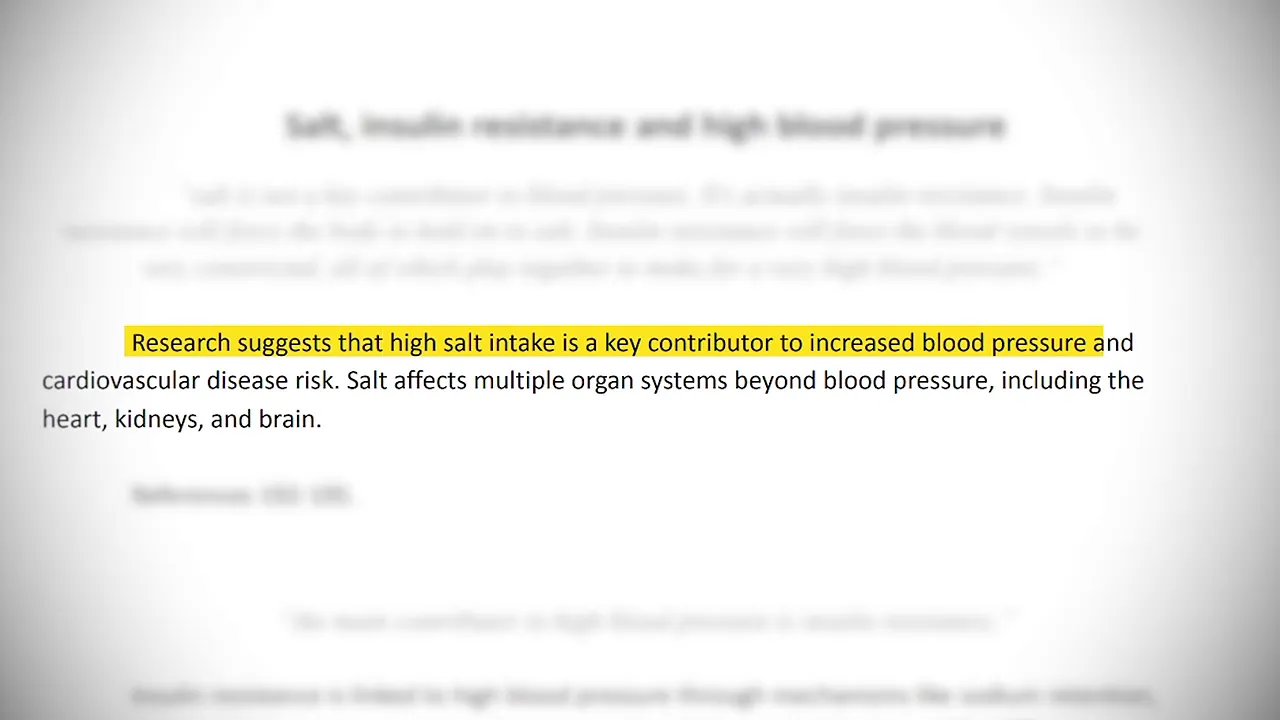
The PDF gets this right. Sodium is not the only determinant of blood pressure, and individual salt sensitivity varies. But controlled experiments that meaningfully change sodium intake show corresponding changes in blood pressure.
The guest’s counterargument is that telling people to reduce salt often produces little improvement. That confuses the effect of advice with the effect of actually changing intake. If people do not substantially reduce sodium, we should not expect a large sodium-related result.
The World Health Organization’s sodium guidance describes excessive intake as a major public-health problem. Average consumption is roughly twice recommended levels, and excess sodium is linked to millions of deaths worldwide.
Whole fruit and chronic disease
Another guest blames excessive fruit consumption for coronary artery disease, diabetes, and fatty liver.
We are talking about whole fruit, such as an apple, not simply treating every product containing fruit as nutritionally identical.
Western populations generally underconsume whole fruit. More importantly, people who eat more whole fruit tend to have lower risks of cardiovascular disease and diabetes, not higher risks.
The episode’s research PDF explains that higher fruit consumption is associated with cardiometabolic protection rather than increased disease risk. It also makes a useful distinction: fruit juice and dried fruit are not identical to intact whole fruit, and excessive intake deserves separate consideration.
That is careful communication. Yet the episode remained available, the disputed fruit claim was highlighted in its introduction, and a separate short clip circulated without the accompanying correction.
This is the problem in miniature: the surprising claim gets the promotion; the evidence gets a document link.
Fiber and digestive health
The psychiatrist’s fiber claim receives a similar treatment. The research PDF describes fiber’s roles in shaping bacterial communities, supporting the intestinal lining, and maintaining digestive health.
It also emphasizes that fiber’s effects depend on its behavior inside the digestive system. Again, biological compartments matter.
Rather than supporting the idea that fiber is dispensable, the document notes that many people consume less than half the recommended amount and would benefit from more high-fiber foods.
Cancer, ketones, and mitochondria
The original cancer interview attracted more than 10 million plays, but I found no research PDF or comparable correction attached to it at the time of this investigation.
When the professor returned later, however, the accompanying document was substantial: around 100 pages and more than 400 scientific references.
Its conclusions were far more careful than the guest’s:
- Some cancer cells can use ketones for energy and growth, with effects varying by tumor model.
- Other experimental models show neutral or inhibitory effects, making them candidates for further study.
- The evidence is largely preclinical, sometimes contradictory, and uncertain in its clinical application.
- Many tumors retain functional mitochondria and depend on mitochondrial respiration.
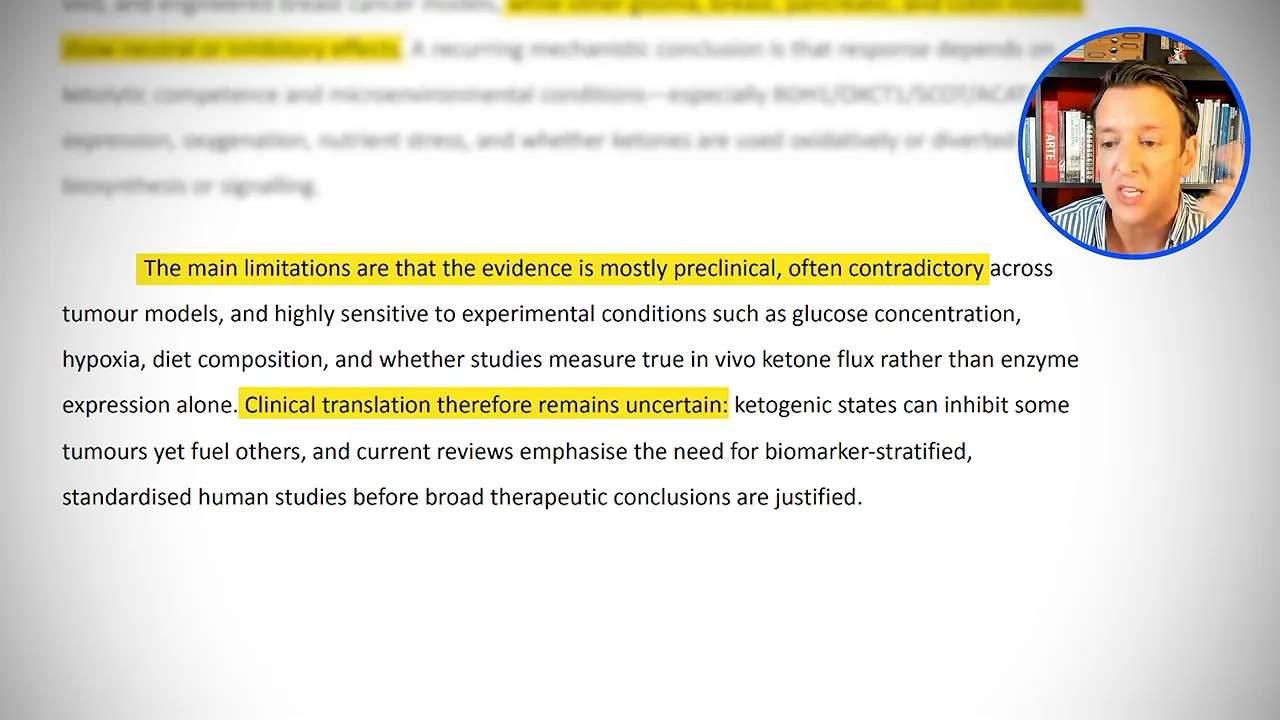
These are not minor disagreements about wording. They challenge the foundations of the guest’s explanation.
In the examples I examined, I did not find a case where the PDF was wrong and the guest was right. Whoever is preparing these documents is doing work that deserves far more prominence.
Why PDFs and On-Screen Notes Are Not Enough
The research documents deserve credit. But their existence does not make the interviews reliable.
First, not every episode has one. Some of the most concerning examples lack comparable corrections.
Second, a link buried among promotional material is easy to miss. A document running to 100 pages with hundreds of references is not an accessible correction for most people. Finding the document, locating the relevant section, and recognizing that it contradicts the interview requires considerable effort.
Third, podcasts are frequently consumed as audio. A written correction does nothing for someone who never encounters it.
The podcast later introduced on-screen fact checks, described as community notes. In the returning cancer interview, a note explains that preclinical studies show different abilities to use ketones across cancer types and that the evidence does not support a universal inability to use them.
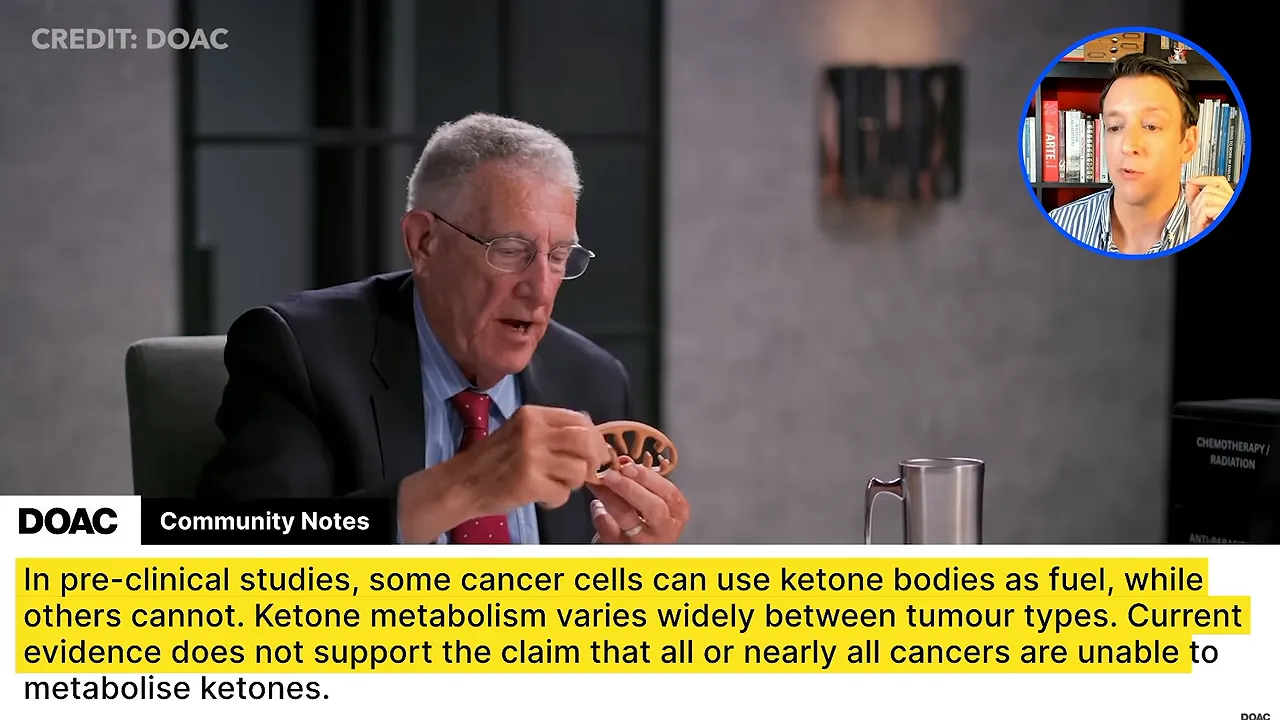
That is a meaningful improvement, and I give them credit for it.
It still misses anyone listening while driving, exercising, or doing something else. A correction needs to reach people in the same format as the claim. Otherwise, the confident assertion may be heard clearly while its essential qualification goes unnoticed.
Better Fact-Checking Does Not Require Censorship
None of this means unconventional guests should be excluded from public discussion. I have invited people with some of these views into conversations myself.
The productive approach is straightforward: let a guest explain the idea fully, introduce the strongest contradictory evidence, and give them an opportunity to respond.
That is not censorship. It is an informative interview.
A large podcast has several practical options:
- Bring in a research-informed third participant. The host does not have to become a scientist overnight. Another participant can provide the necessary evidence and context, as Dr. Mike has done in discussions with Dr. Gundry.
- Research predictable claims before recording. A returning guest’s central theory is hardly a surprise. The team already preparing detailed PDFs could identify the strongest counterevidence and turn it into clear questions for the host.
- Check simple factual assertions during the conversation. A broad statistical claim about heart disease trends can be checked, clarified, and discussed immediately rather than left unchallenged.
For example: some studies suggest that certain cancer cells can use fatty acids or ketones. How does the guest reconcile that with the claim that they cannot?
Or: the mortality data show substantial declines. Which measure, population, and period does the guest mean when saying heart disease is getting worse?
These questions can be asked politely. Cordiality and scientific scrutiny are perfectly compatible.
Would more visible challenges make an episode less viral? I do not know. But popularity is not the standard by which health information should be judged.
Blood Sugar Fear Becomes a Supplement Sales Pitch
The financial concerns become particularly clear in an episode about glucose.
A guest argues that even people without health problems commonly experience glucose spikes, then connects those spikes to a wide range of problems, including mental health symptoms, fertility, acne, and accelerated aging.
There is a basic distinction missing here: a normal post-meal rise in blood glucose is not, by itself, a disease.
After a meal containing carbohydrate, glucose enters the bloodstream and is transported to tissues. In a healthy person, levels subsequently come down. After a meal containing fat, circulating fats also rise as nutrients are transported.
These are normal physiological processes. The fact that a measurement changes does not establish that the change is harmful.
Whole fruit, whole grains, beans, and lentils can raise blood glucose after eating. Yet higher consumption of these foods is associated with lower risks of diabetes, heart disease, and mortality. Exercise can also temporarily raise glucose. That does not make exercise unhealthy.
This is not a claim that every glucose pattern is harmless, or that diabetes does not matter. It is a rejection of turning ordinary physiology in otherwise healthy people into an automatic reason for fear.
Evidence for ingredients is not evidence for the finished pill
Later, the conversation promotes a supplement intended to blunt glucose spikes.
When I investigated, I found no published human trial testing the exact formulation being sold for effectiveness and safety. The product combined existing herbs and supplement ingredients, but a collection of ingredient studies does not establish what the finished mixture does.
Biologically active substances can interact. Combining them may change their effects, reduce an expected benefit, or introduce new adverse effects. “Natural” is not a safety guarantee; some supplements can cause liver injury.
Supplement regulation also does not generally require the same premarket demonstration of safety and effectiveness expected for medicines. Being available for purchase is not equivalent to having passed a clinical trial.
The sales pitch becomes especially striking when the guest discourages alternatives such as berberine and vinegar capsules while directing people toward her own product.
At the prices examined, a month of berberine could cost around $5 to $10, while the promoted supplement cost $75 a bottle. Berberine had dozens of randomized trials behind it; I found none on the exact branded formulation.
That comparison is not a recommendation to take berberine. It highlights the mismatch between the confidence of the marketing and the evidence supporting the product being promoted.
Referral Links and the Conflict-of-Interest Problem
Why would an interview platform devote so much attention to a guest’s supplement?
The episode description links to its sales page. Following that link reveals referral-tracking information associated with Branch, a service that can identify where traffic originated and attribute resulting activity to the referring source.
That is the infrastructure commonly used in affiliate marketing: identify the referral, track the purchase, and potentially credit compensation to the referring partner.
A tracking link alone does not disclose the commercial contract, commission rate, or money actually received. It does, however, raise a legitimate conflict-of-interest question, particularly when an interview first encourages concern about normal glucose fluctuations and then promotes a product intended to suppress them.
The commercial message is powerful: you may think you are healthy, but you have this problem too, and here is something to buy.
The same pattern extends to books
The glucose episode also repeatedly promotes the guest’s book, including a personal endorsement from the host. Its linked sales route uses Branch’s app.link domain and referral attribution.
The psychiatrist who dismisses the need for fiber also promotes a book. The host holds it up and recommends it, and the associated link again uses referral tracking.
Selling books is not inherently wrong. Selling supplements is not automatically evidence of wrongdoing. Nor does a financial interest, by itself, prove that a particular claim is false.
But commercial relationships matter when evaluating how a conversation is framed. If sales can be attributed to the platform, there is a potential incentive to make the product appealing and the guest authoritative.
That deserves scrutiny, not an assumption that the interview is a neutral science lesson.
The Bigger Problem: Accuracy Competing With Virality
My concern is the combination of three things: sensational health claims, corrections that often receive much less attention, and promotional structures that can reward sales.
A large social-media following is not evidence of scientific expertise. A guest’s ability to generate a viral episode does not establish that their medical claims are sound.
My interpretation is that the podcast has built a strong incentive to feature surprising, contrarian ideas. The research PDFs suggest that its team has access to evidence showing where some of those ideas fail. Yet the dramatic claims remain central to the content and its promotion.
I cannot establish the private motives behind every editorial choice. What I can assess is the public output: what was claimed, what the evidence supports, how the podcast’s own notes respond, and what products are promoted alongside it.
This is also why I do not sell supplements and turn down sponsorships. Financial incentives can make an already complicated task even murkier.
The lesson is not to reject every podcast, every unconventional idea, or every person who sells a book. It is to stop confusing confidence, credentials, popularity, and commercial polish with reliable evidence.
A responsible health conversation should test its most important claims where everyone can hear the answer. It should distinguish laboratory hypotheses from established treatments, ordinary physiology from disease, and education from a sales pitch. A correction hidden somewhere else is not enough.
This article is for educational purposes, not individual medical advice. Do not stop prescribed medication or cancer treatment because of a podcast claim. Discuss treatment decisions with a qualified healthcare professional.


