Can very high LDL cholesterol be harmless if the particles are large rather than small and dense? Does cutting sugar out of the diet prevent heart disease? And did the American Heart Association really announce that total cholesterol is unrelated to cardiovascular risk?
These are central claims in Dr. Eric Berg’s discussion of his wife’s cholesterol results. They are also common ideas online, so understanding where the reasoning goes wrong is useful far beyond this particular example.
My approach is simple: focus on the claims, not the person. Someone can be friendly, sincere, and genuinely concerned about health while still getting the science wrong. The question is whether the explanation matches the evidence.
Key Takeaways
- Dietary cholesterol and blood cholesterol are different measurements, and evidence about one cannot automatically explain the other.
- Both large and small LDL particles can contribute to plaque; particle number matters more than size.
- ApoB helps assess particle burden when cholesterol measurements do not fully capture it.
- Replacing refined carbohydrates with whole grains or polyunsaturated fats is more beneficial than simply removing sugar.
Table of Contents
- Dietary Cholesterol and Blood Cholesterol Are Not the Same Thing
- Why ApoB Is More Informative Than Total Cholesterol
- Are Large LDL Particles Harmless?
- “Large” LDL Is Still Small Enough to Enter the Artery Wall
- Do You Need an Advanced Lipid Test?
- Small Dense LDL Can Be a Marker Without Making Large LDL Safe
- Cutting Sugar: What You Eat Instead Matters
- Heart Disease Is Not About One Thing
- What These Results Actually Call For
- Trust the Evidence, Not the Delivery
Dietary Cholesterol and Blood Cholesterol Are Not the Same Thing
The first claim is that the 2018 American Heart Association guidelines found no significant relationship between total cholesterol and heart disease.
That is not what those guidelines say.
The 2018 cholesterol guidelines describe population evidence suggesting that total cholesterol around 150 mg/dL is associated with low rates of atherosclerotic cardiovascular disease. Total cholesterol is not our most informative marker, but that is very different from saying it has no association with risk.
Where does the confusion come from? The supporting document shown in Berg’s discussion is an American Heart Association advisory about dietary cholesterol, not total cholesterol in the blood.
- Dietary cholesterol is the cholesterol in food, such as eggs or butter.
- Serum cholesterol is the cholesterol circulating in the blood, measured through blood work.
- Total cholesterol on a laboratory report refers to the total amount of cholesterol carried in the blood across different lipoproteins.
These are related concepts, but they are not interchangeable. It is possible to have high blood cholesterol while eating no dietary cholesterol at all.
Think of potassium. The potassium content of a meal and your blood potassium level are different measurements. A statement about one cannot simply be transferred to the other.
The advisory’s discussion of studies finding no significant association between dietary cholesterol and cardiovascular disease does not establish that blood cholesterol is unrelated to cardiovascular disease. Dietary cholesterol has shown associations with risk in some studies and not others, depending on several factors. That is a separate question.
Total blood cholesterol does associate with cardiovascular risk. We simply have better ways to assess the lipoprotein-related component of that risk.
Why ApoB Is More Informative Than Total Cholesterol
There is an important point Berg gets right: cholesterol does not travel freely through blood on its own.
Lipids do not mix well with the watery environment of blood plasma. They travel in particles called lipoproteins. This distinction matters because public discussion tends to focus almost entirely on cholesterol, including “good” and “bad” cholesterol, while paying less attention to the particles carrying it.
Here is a useful analogy:
- Lipoprotein particles are vehicles.
- Cholesterol is cargo carried inside those vehicles.
- ApoB provides a measure of the number of potentially plaque-forming vehicles.
Total cholesterol and LDL cholesterol measure the cholesterol cargo. They give us indirect information about how many particles are circulating, but the amount of cholesterol per particle can vary.
Apolipoprotein B, usually shortened to apoB, is a structural protein carried by these particles. Measuring it gives us a much closer assessment of particle number rather than just their cholesterol content.
Within this group of lipid-related measurements, LDL cholesterol is more useful than total cholesterol, non-HDL cholesterol can be more informative still, and apoB gets closest to the underlying particle burden we are concerned about.
That does not mean apoB tells us everything about someone’s cardiovascular health. It means that, for assessing the burden of these lipoproteins, counting the vehicles is more informative than measuring their passengers.
Are Large LDL Particles Harmless?
In the blood work discussed, total cholesterol is 261 mg/dL and LDL cholesterol is 195 mg/dL. An additional test reports LDL particle number, or LDL-P, at 2,128. Berg then emphasizes a small dense LDL result reported as optimal and concludes that the elevated LDL is predominantly the large, buoyant type.
The implication is that the high LDL is not a problem because small dense particles are the dangerous ones.
This is a very common argument. Unfortunately, it leaves out the most important variable.
The traffic-jam problem
Imagine two otherwise identical roads carrying the same number of people. Road A has more traffic jams than Road B.
We investigate and discover that Road A has mostly compact cars, while Road B has more vans and buses. Should we conclude that small vehicles cause traffic jams?
Not so fast. If the same number of people are traveling in smaller vehicles, there may be more vehicles on Road A.
We now have two possible explanations: vehicle size and vehicle number. We cannot identify the cause just by noticing that the congested road has smaller cars.
The same issue arises with LDL. At a given LDL cholesterol concentration, people with smaller particles tend to have more particles to carry that cholesterol. People with predominantly small LDL, sometimes called pattern B, often have higher cardiovascular risk. But is that because the particles are smaller, or because there are more of them?
A review of LDL particle number and cardiovascular risk explains this exact problem. Comparing people at the same LDL cholesterol level does not isolate particle size, because particle number differs too.
What happens when researchers account for particle number?
Researchers can use statistical analyses to examine whether particle size predicts risk independently of particle number.
Across the evidence discussed, the association between LDL size and cardiovascular risk typically loses significance after accounting for particle concentration, including apoB. Particle number is the more informative predictor.
An analogy helps here. People who own ashtrays may have higher rates of lung cancer. But that does not mean the ashtrays are causing the cancer. Smoking explains the relationship much better.
Some nonsmokers own ashtrays for guests, and some smokers do not own ashtrays at all. Once smoking is accounted for, ashtray ownership becomes much less informative.
Likewise, small LDL size can correlate with risk without being the main reason for that risk. These statistical analyses are not, by themselves, a complete proof of causation. That is why it is important to examine other lines of evidence too.
Two more reasons large LDL is not benign
- Statins lower cardiovascular risk while preferentially reducing large LDL particles. That is difficult to reconcile with the idea that large LDL is harmless.
- People with familial hypercholesterolemia often have predominantly large LDL particles and high cardiovascular risk. Large particles clearly do not protect them from premature atherosclerosis.
The practical conclusion is not that small dense LDL is irrelevant. It is that a favorable particle-size result does not cancel out a high particle count.
“Large” LDL Is Still Small Enough to Enter the Artery Wall
The labels “small” and “large” can create a misleading mental picture. Large LDL sounds like something too bulky to enter an artery wall. In reality, both types are tiny.
The approximate diameters illustrated in this discussion are:
- Small dense LDL: about 18 to 21 nanometers.
- Large LDL: about 21 to 23 nanometers.
- IDL, or intermediate-density lipoprotein: roughly the mid-20-nanometer range.
- VLDL, or very-low-density lipoprotein: a broader range, including particles around 60 nanometers and some larger than 70 nanometers.
A nanometer is one-millionth of a millimeter. The difference between small and large LDL is modest compared with the full size range of apoB-containing lipoproteins.
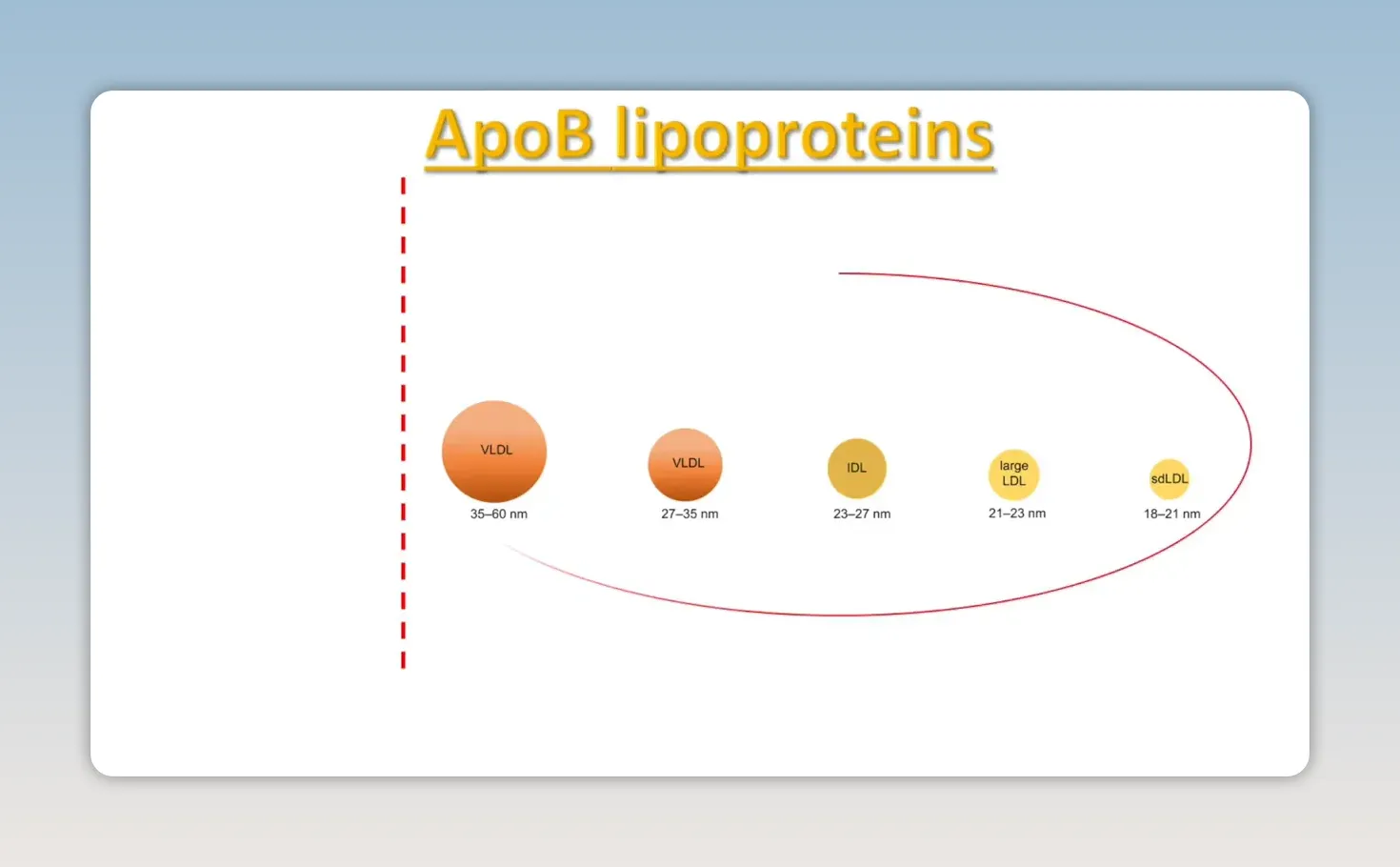
A useful approximate threshold is 70 nanometers. ApoB-containing particles below that size, including LDL and VLDL remnants, can cross the endothelial barrier, the lining of the artery wall, and become retained there. The very largest VLDL particles are too large to enter readily.
Notice where LDL falls on that scale. Even large LDL is nowhere near the threshold. Both small and large LDL can contribute to atherosclerosis, as can some particles substantially larger than either.
Genetic evidence strengthens the particle-number explanation
Genes influence lipoproteins, just as they influence height or eye color. Researchers can study variants affecting different lipoprotein pathways to investigate how those changes relate to cardiovascular disease.
A genetic analysis of LDL- and triglyceride-related pathways found results consistent with approximately similar cardiovascular effects per apoB-containing particle across the LDL and VLDL pathways studied.
Put simply, the reduction in risk per reduction in VLDL particle number was similar to the reduction in risk per reduction in LDL particle number. This strengthens the argument that particle number, rather than the cholesterol content or LDL size category alone, is central.
Genetic analyses have their own assumptions, but they help address some of the limitations of ordinary observational correlations. Together with the other evidence, they make the “large LDL is safe” argument very difficult to defend.
The goal is to keep the overall burden of plaque-forming apoB particles in a healthy range, not to keep one subtype low while allowing the others to become very high.
Do You Need an Advanced Lipid Test?
Berg recommends advanced testing to distinguish LDL particle sizes. But a test is not automatically useful just because it produces more numbers.
A proposed marker should improve risk assessment beyond information we already have, or offer a meaningful practical advantage, such as lower cost. Knowing whether LDL is slightly larger or smaller usually does not change the central goal: reduce an excessive burden of apoB-containing particles.
A review of LDL subclasses and cardiovascular disease concludes that LDL subclass measurements do not add independent information beyond particle concentration and standard risk factors.
Those other factors include diabetes, smoking, blood pressure, and family history. Particle size should not distract us from them either.
It also helps to distinguish the tests:
- LDL-C measures the cholesterol carried within LDL.
- LDL-P measures LDL particle concentration.
- ApoB reflects the concentration of a broader group of apoB-containing particles, including LDL.
- LDL subtyping characterizes particle sizes or subclasses.
LDL-P and apoB are closely related measures of particle burden, although they are not identical. In the blood work discussed, both were elevated. That is the finding to focus on, rather than using the small dense LDL result as reassurance.
If you already have particle-size testing, there is no need to panic about having extra information. Just do not let it obscure the information that matters more.
For people who do not know their apoB, LDL cholesterol and non-HDL cholesterol provide useful indirect estimates. In some people, however, cholesterol measurements and particle number do not line up well. When there is uncertainty, discussing an apoB measurement with a clinician can help clarify the picture.
And if someone wants to pursue larger LDL particles, the key condition is that this should not come at the expense of a higher particle count. Making the vehicles larger is not a meaningful improvement if it also puts more of them on the road.
Small Dense LDL Can Be a Marker Without Making Large LDL Safe
Small dense LDL is associated with several metabolic problems, including:
- Insulin resistance.
- Diabetes.
- Obesity.
So it is hardly surprising that it also associates with cardiovascular disease. It can provide a signal of a broader metabolic problem.
But that does not make it a uniquely definitive test of inflammation, nor does it establish that larger LDL particles are harmless.
This is the distinction between a marker and a cause. A marker may help identify people at risk without being the factor that needs to change to reduce that risk.
Correlations are a starting point. To understand what is driving disease, we need to go further, using statistical analyses, genetics, and clinical trials. Otherwise, it is easy to overvalue an associated feature while overlooking the causal factor.
Cutting Sugar: What You Eat Instead Matters
Another claim is that the vascular damage leading to a stroke can be completely prevented simply by removing sugar from the diet.
Reducing excess refined sugar is sensible. But “remove sugar and prevent cardiovascular disease” is an oversimplification.
First, cardiovascular disease has multiple causes. Second, changing a diet always raises a replacement question: what takes the place of the food you remove?
Research comparing replacements for refined carbohydrates helps make this concrete. Refined carbohydrates include foods such as table sugar, candy, white bread, and many baked goods.
- Replacing refined carbohydrates with whole grains was associated with lower coronary heart disease risk. Examples include oats, brown rice, and whole wheat bread.
- Replacing them with polyunsaturated fats was also associated with lower risk.
- Replacing them with monounsaturated fats showed a tendency toward lower risk, but that comparison was not statistically significant in the analysis discussed.
- Replacing them with saturated fat was not associated with a statistically significant improvement in risk.
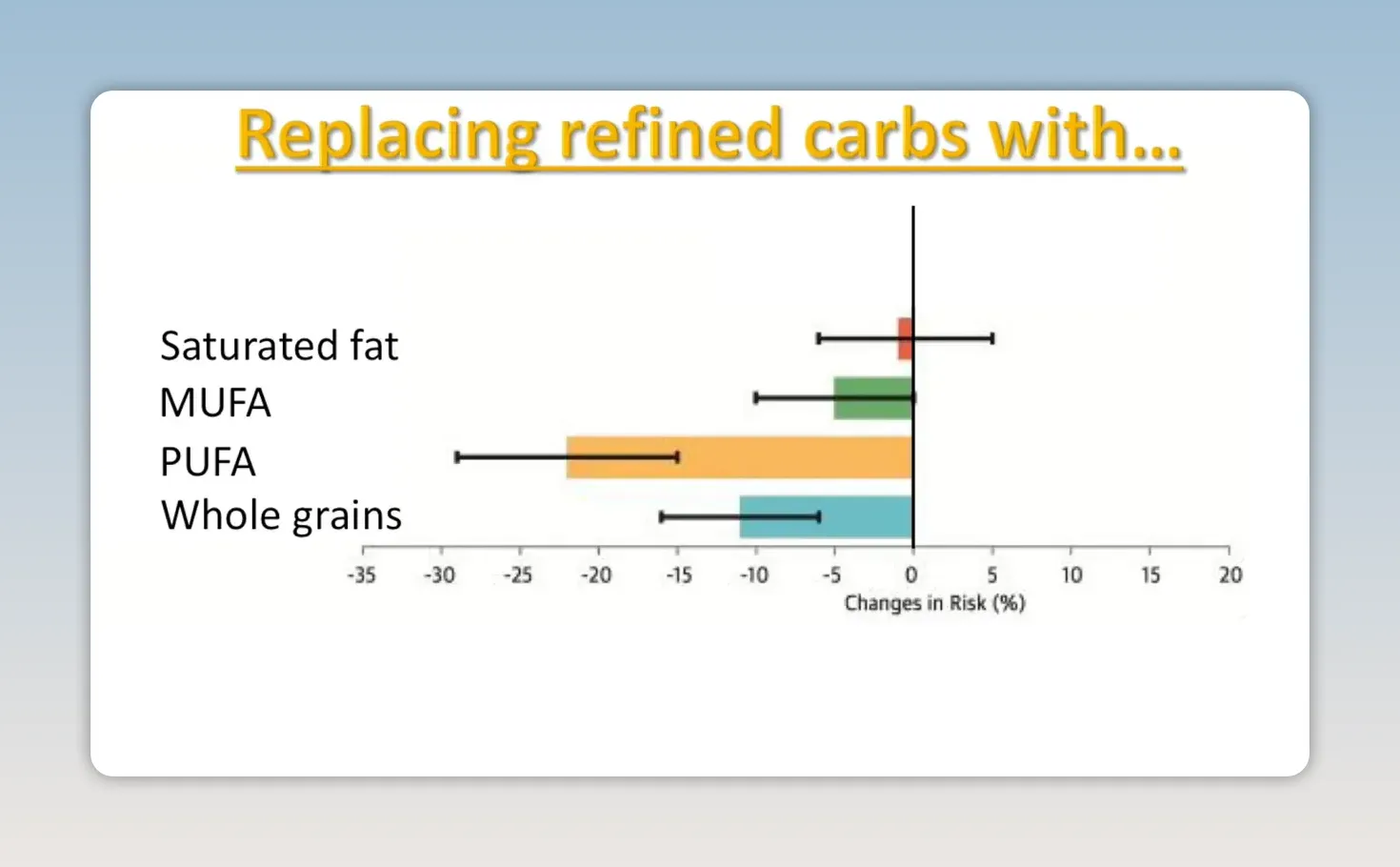
The research on carbohydrate and fat substitutions illustrates why nutrition advice needs to consider both sides of the swap.
Sources of unsaturated fat include nuts, seeds, most vegetable oils, and fatty fish. Foods rich in saturated fat include butter, fatty meats, and coconut oil.
This does not mean a healthy dietary pattern can never contain butter or red meat. It is about proportions and the overall substitution. Replacing a large share of refined carbohydrates, calorie for calorie, with saturated fat is not the cardiovascular upgrade that replacing them with whole grains or polyunsaturated fats appears to be.
So yes, moderate added sugars and refined carbohydrates. But aim to replace them with foods that improve the dietary pattern, rather than assuming that anything without sugar must be better.
Heart Disease Is Not About One Thing
Whenever someone says heart disease is “all about” one factor, get your guard up.
ApoB is a major contributor to atherosclerotic risk. It is not the whole picture. Cardiovascular health also involves:
- Blood pressure.
- Diabetes and metabolic health.
- Smoking.
- Inflammation.
- Physical activity.
- Body weight.
- Family history and inherited disorders.
Improving one factor does not make the others disappear. Avoiding sugar does not neutralize a high apoB. Having large LDL particles does not neutralize a high particle count.
What These Results Actually Call For
With markedly elevated LDL cholesterol, LDL-P, and apoB, the evidence-based priority is to address the elevated particle burden, not dismiss it because the small dense LDL measurement looks favorable.
A cardiologist or lipid specialist can assess the full clinical picture. With numbers this high, that evaluation may include considering familial hypercholesterolemia or other lipid disorders. Whether the levels have always been elevated or rose recently also matters.
Blood work alone is not enough to diagnose an inherited condition, and an online discussion cannot replace an individualized assessment.
ApoB can be lowered through lifestyle changes, medication, or a combination, depending on the person and the degree of elevation. The useful question is which approach brings the relevant risk factors into a healthier range, not which explanation makes a concerning result sound reassuring.
Trust the Evidence, Not the Delivery
There is no need to assume bad intentions here. Someone discussing a spouse’s health presumably wants that person to be safe and healthy. Sincerity and accuracy are simply different things.
People can encounter unreliable ideas, accept them uncritically, and repeat them with complete conviction. A calm delivery and a persuasive explanation do not resolve that problem.
The lesson is broader than any one person: check whether the reference addresses the actual claim, distinguish association from causation, and look for agreement across different kinds of evidence.
Dietary cholesterol is not blood cholesterol. Large LDL is not harmless LDL. And a favorable particle-size result is not a reason to ignore a high apoB.
This article is for educational purposes and is not medical advice, diagnosis, or treatment. Discuss abnormal lipid results and treatment decisions with a qualified healthcare professional.


