Plants contain defensive chemicals. Our ancestors ate meat. Cholesterol is essential for life. People report feeling better on a carnivore diet.
All interesting points. But none, by itself, answers the question we actually care about: What happens to our health when we eat a particular diet for years or decades?
Dr. Paul Saladino’s appearance on Joe Rogan’s podcast brings together many familiar nutrition arguments, including a striking report of LDL cholesterol at 533 mg/dL. The useful response is not to pick a dietary team or trade personal stories. It is to examine the evidence behind each claim and apply the same standards consistently.
That last part matters. A weak argument does not become stronger because it supports a diet we happen to like.
Key Takeaways
- Individual food compounds and ancestral diet stories cannot establish a diet’s long-term health effects.
- Feeling better on a restrictive diet does not prove that the diet is safe long term.
- Randomized trials support replacing saturated fat with unsaturated fat to reduce cardiovascular events.
- Clinical trials and genetic evidence consistently support LDL’s causal role in atherosclerotic cardiovascular disease.
Table of Contents
- Do Plant Defense Chemicals Make Plants Unhealthy?
- Essential Nutrients Are Not a Complete Scorecard for Health
- Three Types of Nutrition Evidence, and Why They Matter
- “Eat What We Evolved to Eat” Sounds Better Than It Works
- Feeling Better Matters, but It Does Not Prove Long-Term Safety
- What Randomized Trials Say About Saturated Fat
- Vegetable Oils and the Question Everyone Should Ask: Replaced With What?
- Cholesterol Is Essential. That Does Not Make High LDL Harmless.
- The LDL Evidence Is Not Just Correlations
- The Real Lesson: Apply the Same Standards to Every Diet
Do Plant Defense Chemicals Make Plants Unhealthy?
The opening argument is that most plants are not edible, whereas most animals are. Even accepting that comparison, what does it tell us about the health effects of the foods we actually eat?
Not much. There are tens of thousands of edible plant species. Those foods could theoretically be beneficial, harmful, or somewhere in between. Counting the inedible species does not settle the question. The same applies to edible animals.
Then comes a more specific claim: plants produce defensive chemicals called phytoalexins, so perhaps eating plants is bad for us.
That is a hypothesis. Now we have to test it.
A review of phytoalexins describes not only their role in protecting plants against microbes, but also research into potentially beneficial biological effects. These include anticancer activity and protection of nerve cells in experimental settings. Resveratrol is a familiar example.
Does that mean we should eat plants specifically to load up on phytoalexins? No. Laboratory findings about a molecule are not the same as evidence that eating a food prevents disease. But those findings certainly do not support the blanket claim that plant defense chemicals make plant foods unhealthy.
The same mistake appears on both sides of the diet debate
This is not a problem unique to carnivore arguments. People also argue against animal foods by pointing to individual molecules, such as TMAO or heme iron.
I stopped using TMAO as a reason to make a dietary choice when evidence raised questions about whether it causes disease or may instead act as a marker. That distinction matters. A molecule being associated with disease does not automatically mean it causes it.
The standard should be the same for eggs, vegetables, meat, or anything else:
Do we have evidence that eating this food, in realistic amounts and in its normal dietary context, causes harm in humans?
Not a purified compound at an enormous dose. Not just an experiment in mice. Not just a plausible biochemical story.
Otherwise, we can eliminate plants because of lectins and phytoalexins, eliminate animal foods because of TMAO and heme iron, and eventually arrive at a very effective diet for starvation.
Essential Nutrients Are Not a Complete Scorecard for Health
Another claim is that animal foods provide all the nutrients found in plants, in equivalent or more bioavailable forms.
The charitable interpretation is that this refers to essential nutrients. Plants contain many distinctive compounds called phytonutrients, but not every biologically active compound is classified as essential.
Even if we establish that a diet supplies every essential nutrient, however, we have not established that it is optimal for long-term health.
Imagine meeting essential nutrient requirements with a combination of junk food and supplements. Would that automatically make the diet healthy? Of course not.
Nutrient adequacy and long-term disease risk are different questions. A diet can prevent a deficiency without being the best choice for cardiovascular health or healthy aging.
Reducing foods to a short list of nutrients has the same basic weakness as reducing them to one supposedly dangerous molecule. Both approaches can lose sight of the actual health effects of the whole diet.
Three Types of Nutrition Evidence, and Why They Matter
To evaluate these claims, it helps to sort nutrition research into three broad categories. Think of them as three bags of evidence.
- Laboratory research: experiments in cells, test tubes, or animals. These can reveal mechanisms and generate hypotheses.
- Observational population studies: researchers record what people eat and examine how their diets relate to health outcomes. These identify associations, but confounding and measurement errors complicate causal interpretation.
- Randomized controlled trials: volunteers are randomly assigned to interventions, such as different diets or treatments, and researchers compare the outcomes.
Human evidence generally carries more direct relevance than laboratory findings. And, all else being equal, a well-designed randomized trial provides stronger causal evidence than an observational correlation addressing the same question.
That does not mean randomized trials are perfect or observational studies are useless. Study quality, duration, and the question being asked all matter. But the broad hierarchy is reasonable.
So when Saladino emphasizes the limitations of epidemiology and the importance of intervention studies, I agree with the gist of that point.
The problem comes when that standard is applied selectively: dismissing modern population research as “just correlations,” then leaning on ancestral speculation, testimonials, or national food-consumption trends instead.
“Eat What We Evolved to Eat” Sounds Better Than It Works
The evolutionary argument feels compelling: surely our bodies should do best on the foods our ancestors ate.
Maybe. But many ideas feel intuitively right and fail when tested. That is routine in science.
First, our ancestors did not eat one uniform diet. Food availability varied by geography and circumstances. Some populations consumed more animal foods; others relied heavily on plants.
Archaeological findings include:
- Evidence of grass seed consumption roughly 100,000 years ago, including sorghum.
- Evidence that Paleolithic people processed wild plants, including oats, into flour about 30,000 years ago.
- Evidence of cooking starchy underground plant foods about 170,000 years ago.
- Findings consistent with consumption of nuts, fruits, seeds, vegetables, and a varied range of other plants.
Yes, the Paleolithic diet included food processing. That does not make every processed food healthy. It simply shows how easily a tidy ancestral story falls apart.
Does ancient grain consumption prove whole grains are healthy? No. Does ancient meat consumption prove a carnivore diet is healthy? Also no.
Evidence that a food was eaten is not evidence of its long-term health effects.
Fossils do not solve the limitations of modern nutrition research
It is inconsistent to reject a carefully conducted modern population study because food intake is measured imperfectly, then treat a reconstruction of meals from 100,000 years ago as decisive.
The archaeological record has its own biases. Animal bones tend to preserve better than leaves or fruit. Researchers studying the plant component of an early human diet explicitly discuss how reliance on skeletal remains can bias our picture toward animal foods.
There is also a mismatch between evolutionary survival and our present goals. We want to reduce heart disease and other illnesses across 60, 70, 80, or 90 years. Natural selection does not primarily optimize freedom from diseases that commonly occur after reproduction.
None of this makes evolutionary biology irrelevant. It makes ancestral diet stories a poor substitute for direct health research.
I criticized this reasoning when it was used to promote plant-based eating in The Game Changers. Reversing the dietary conclusion does not fix the argument.
Feeling Better Matters, but It Does Not Prove Long-Term Safety
Testimonials are everywhere in nutrition. Someone feels better eating only plants. Someone else feels better avoiding plants. Another person credits organ supplements.
These experiences may be genuine. They do not establish which diet is superior.
We can find testimonials supporting vegan, keto, carnivore, fruit-only, and many other diets. If a personal success story is enough to prove a diet, we end up “proving” mutually contradictory claims.
That does not mean ignoring your body. Your experience matters to your care, but it is not a controlled scientific experiment.
There is another limitation: feeling good today does not tell us everything about future health. We cannot feel plaque gradually accumulating in arteries. Many diseases develop silently before symptoms appear.
The goal is to interpret personal experience in light of the science, not instead of it.
Can we preserve the benefits while reducing the risks?
I understand why someone might lose confidence in general advice after trying it and feeling worse. Nobody should be told to endure symptoms simply because a recommendation works for most people.
But there may be more than two options. Instead of choosing between feeling miserable and disregarding all medical evidence, we can ask what produced the improvement.
Was it weight loss? Removing a particular food that caused symptoms? Eating fewer calories?
Restrictive diets often reduce energy intake because they eliminate a large share of someone’s usual foods. That can happen with carnivore, keto, or whole-food plant-based eating. Weight loss may explain some of the reported benefits without proving that every feature of the diet is beneficial.
There are many ways to lose weight. They are not necessarily equivalent for long-term health.
Similarly, craving a food does not establish its nutritional value. People crave junk food too. A strong brain response to meat, or any other food, is not a cardiovascular outcomes study.
What Randomized Trials Say About Saturated Fat
Saturated fat is not a villain. Food does not need a cast of heroes and villains.
The question is whether consuming too much of certain saturated fats increases risk, and whether replacing them improves health.
Here, we do not have to rely only on mechanisms or correlations. We have randomized trials and systematic reviews of those trials.
- A 2010 meta-analysis concluded that replacing saturated fat with polyunsaturated fat reduced coronary heart disease in randomized trials.
- A 2017 American Heart Association advisory reported roughly a 30% reduction in cardiovascular disease in selected trials replacing saturated fat with polyunsaturated vegetable oils.
- A 2020 Cochrane review of 15 randomized trials reported a 21% reduction in combined cardiovascular events with reduced saturated fat intake.
Those percentages refer to relative reductions in the outcomes studied, not percentage-point reductions in everyone’s personal risk. The analyses differ in their included trials and methods, but their overall direction is consistent.
Replacing saturated fat with unsaturated fat, particularly polyunsaturated fat, can reduce cardiovascular events.
How much saturated fat is too much?
Zero is neither necessary nor realistic. Even foods such as lettuce contain a little saturated fat.
The 2020 review found evidence of benefit in studies that moved intake from above 10% of calories to below 10%. That broadly aligns with the US dietary guidance to keep saturated fat below 10% of total calories.
Think of that as a practical population guideline, not a biological cliff where risk suddenly changes at one exact number. Individual responses vary.
Blood lipid measurements also help put dietary intake into context. If LDL cholesterol is elevated, reducing saturated fat is one dietary adjustment that may improve it. Good lipid results are useful information, though they do not turn every other aspect of a diet into a nonissue.
Why saturated fat can raise LDL
LDL particles are removed from circulation through LDL receptors. Think of the receptors as docking stations that help clear those particles from the blood.
Too much of certain saturated fats can reduce that clearance, allowing LDL cholesterol to rise.
There is nuance here too: saturated fatty acids are not identical. Stearic acid, found in dark chocolate, is an example that does not raise cholesterol in the same way as several other saturated fats.
Sometimes the science delivers good news.
Vegetable Oils and the Question Everyone Should Ask: Replaced With What?
One argument against vegetable oils points to changes in national consumption alongside changes in heart disease.
But that brings us straight back to correlations. If observational evidence is supposedly too weak to trust, a broad historical correlation does not suddenly become decisive because it supports a preferred conclusion.
Direct trials replacing saturated fat with polyunsaturated oils point in the opposite direction: fewer cardiovascular events.
This does not mean everyone has to eat oils. Nuts, seeds, and olives also provide unsaturated fats. The point is about interpreting evidence consistently.
There is a second mistake in the historical argument: assuming that if saturated fat is a risk factor, reducing it must improve health regardless of everything else.
A risk factor is not the same thing as the only cause. What replaces saturated fat matters:
- Unsaturated fats: replacement can lower cardiovascular risk.
- Whole-food carbohydrate sources: replacement can also lower risk.
- Refined carbohydrates: replacement may provide little or no cardiovascular benefit.
- Trans fats: replacement may be worse.
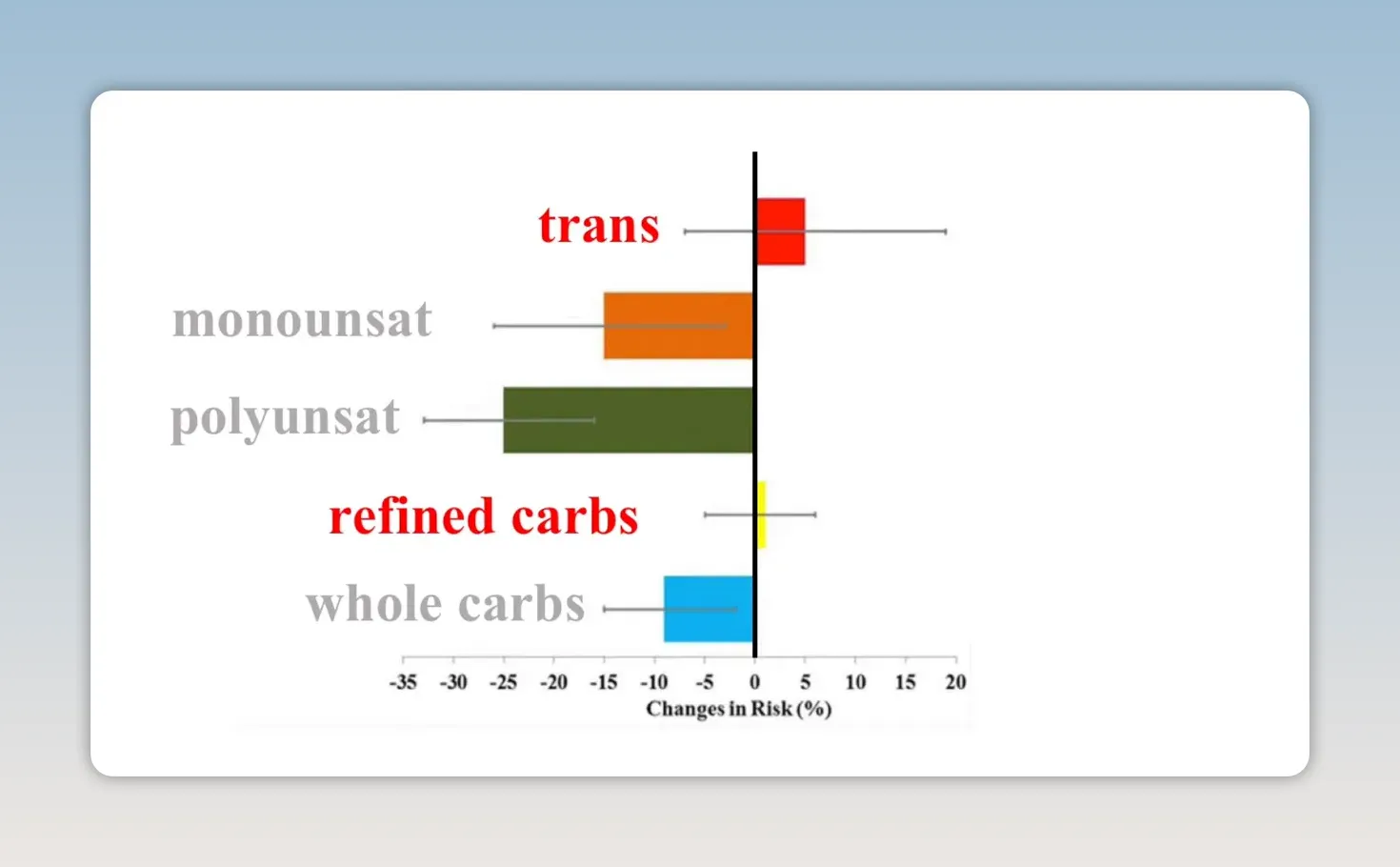
So a population can reduce saturated fat and remain unhealthy if it replaces those calories with other unhealthy foods or changes other risk factors at the same time.
This is why controlled comparisons matter. In national historical data, a thousand things change together. It is difficult to know which changes caused which outcomes.
Cholesterol Is Essential. That Does Not Make High LDL Harmless.
Cholesterol is necessary for normal physiology, including hormone production. Rare genetic disorders that impair cholesterol synthesis can have devastating consequences.
None of that establishes that very high blood cholesterol is safe.
Our bodies normally make the cholesterol we need. We do not have a dietary requirement for it. Eating some cholesterol is not automatically a problem either; the amount and the person’s circumstances matter.
But “we need cholesterol” and “high LDL causes disease” are not contradictory statements.
We need glucose too. That does not make very high blood glucose harmless. Sodium and potassium are essential, but abnormal blood concentrations can be dangerous.
The same basic principle applies here: a necessary substance can cause problems when its level is too high.
This is one reason I dislike calling LDL “bad cholesterol.” We all have LDL, and it has physiological functions. The concern is excessive exposure, not the mere existence of the particle.
The LDL Evidence Is Not Just Correlations
Perhaps the most consequential claim is that the link between LDL cholesterol and heart disease rests on epidemiology and genetic studies, without convincing randomized evidence.
That leaves out one of the main pillars of the science: large randomized clinical trials.
Consider the range of examples:
- Northern Europe: the Scandinavian Simvastatin Survival Study enrolled more than 4,000 people and reported about a 34% reduction in major coronary events.
- United Kingdom: a trial involving about 20,000 people reported an 18% reduction in coronary death and a 27% reduction in major coronary events.
- United States: a pravastatin trial involving more than 4,000 people reported a 24% reduction in major coronary events and a 31% reduction in strokes.
- Scotland: a trial involving roughly 6,000 people reported reductions of about 31% in coronary events and 32% in cardiovascular death.
- Australia: a pravastatin trial involving more than 9,000 people reported 24% fewer coronary deaths and 29% fewer heart attacks.
These are not testimonials or national food-consumption graphs. They are randomized comparisons involving thousands of participants.
Could the benefit be something other than LDL lowering?
That is a reasonable question. A drug can have multiple effects, so a benefit from one medication does not automatically isolate the mechanism.
This is why evidence from different treatments is valuable.
In a trial of evolocumab involving roughly 27,000 people, a different class of LDL-lowering medication reduced cardiovascular outcomes by about 15% to 20%, depending on the endpoint. A trial of another drug class also reported fewer cardiovascular events.
The exact effects vary with the population, treatment, degree of LDL reduction, outcome, and duration. The important point is that the evidence does not depend on one medication acting through one pathway.
Dietary interventions add another line of evidence. Reducing saturated fat can improve LDL clearance through those receptor “docking stations,” while several cholesterol-lowering medications also increase clearance.
Why lifelong LDL exposure matters
When randomized trials, population studies, and genetic studies are considered together, they point in a consistent direction: lower LDL exposure is associated with lower atherosclerotic cardiovascular risk.
But the effect sizes are not identical. Genetically lower LDL often shows a stronger relationship with risk than lowering LDL during a clinical trial.
Why? Duration.
A trial may lower LDL for a few years. A genetic difference can lower it from birth. The cumulative exposure is different.
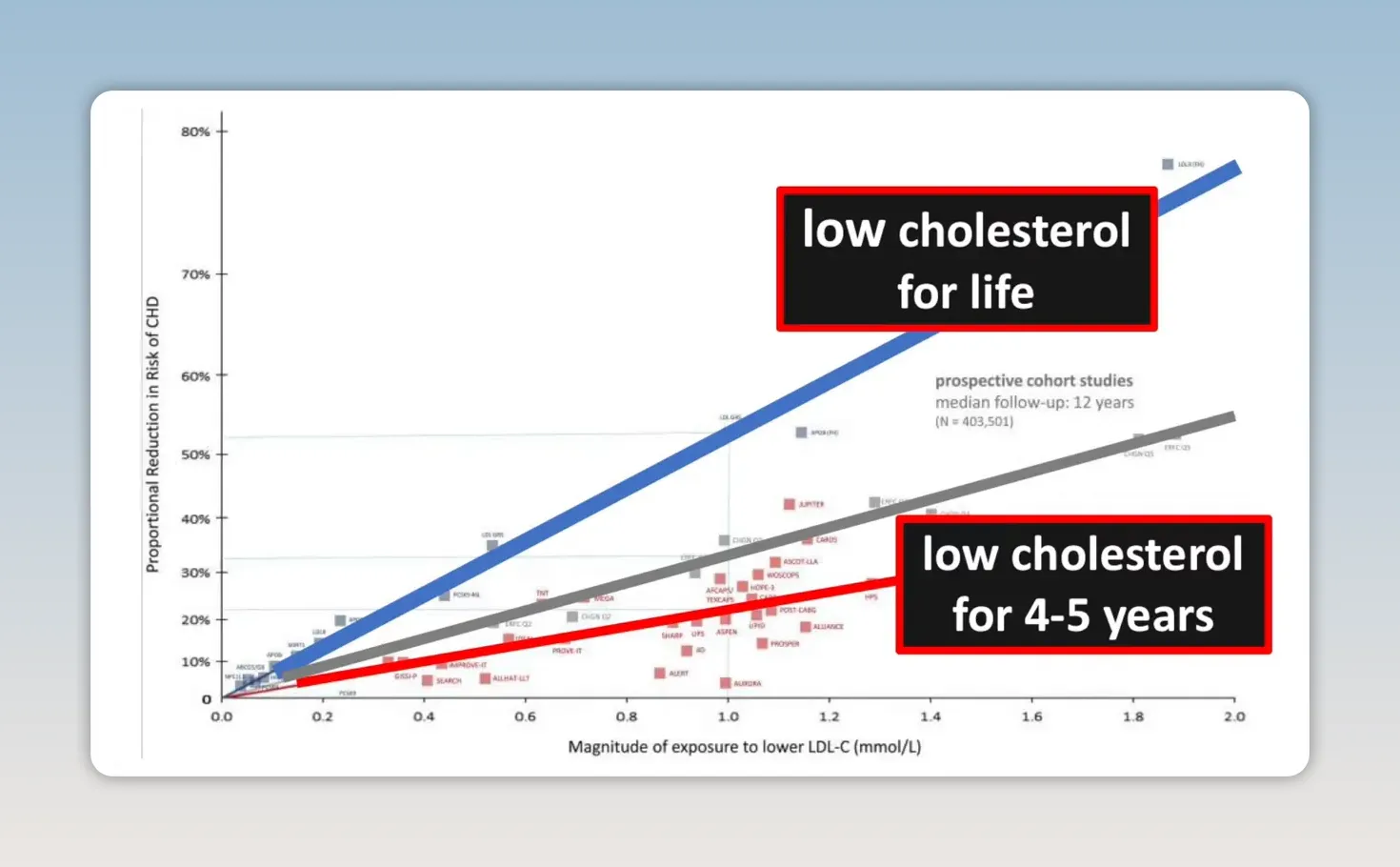
This does not mean people without favorable genetics are doomed. It means addressing elevated LDL earlier can matter.
The European Atherosclerosis Society consensus analysis brings together the clinical and genetic evidence and concludes that LDL causes atherosclerotic cardiovascular disease.
The strength of that conclusion comes from the scale, rigor, and consistency of multiple approaches. Describing it as merely a hypothesis built on weak correlations leaves out a large body of direct experimental evidence.
The Real Lesson: Apply the Same Standards to Every Diet
The purpose of examining these claims is not to attack someone personally. Intelligent, well-intentioned people can repeat arguments they have not fully thought through. I have done it too.
The useful skill is recognizing the pattern the next time it appears:
- A food contains a scary-sounding molecule. Does eating the food actually cause harm?
- A diet supplies essential nutrients. What are its long-term health outcomes?
- Our ancestors ate it. Does that answer the health question we are asking today?
- Someone feels better. Can we identify the benefit without overlooking silent risks?
- Two variables rose together. What do controlled studies show?
For a more extensive examination of the podcast’s claims, Layne Norton and Kevin Bass provide a detailed scientific fact-check.
Whether a diet is carnivore, vegan, keto, or something else, the standard should not change. Personal experience deserves attention. Mechanisms deserve investigation. Evolutionary ideas can generate hypotheses.
But the central question remains what happens to real people’s health, and the strongest available evidence should guide the answer.
This article is for general information, not personal medical advice. Discuss dietary changes, elevated cholesterol, and treatment decisions with a qualified health professional.


